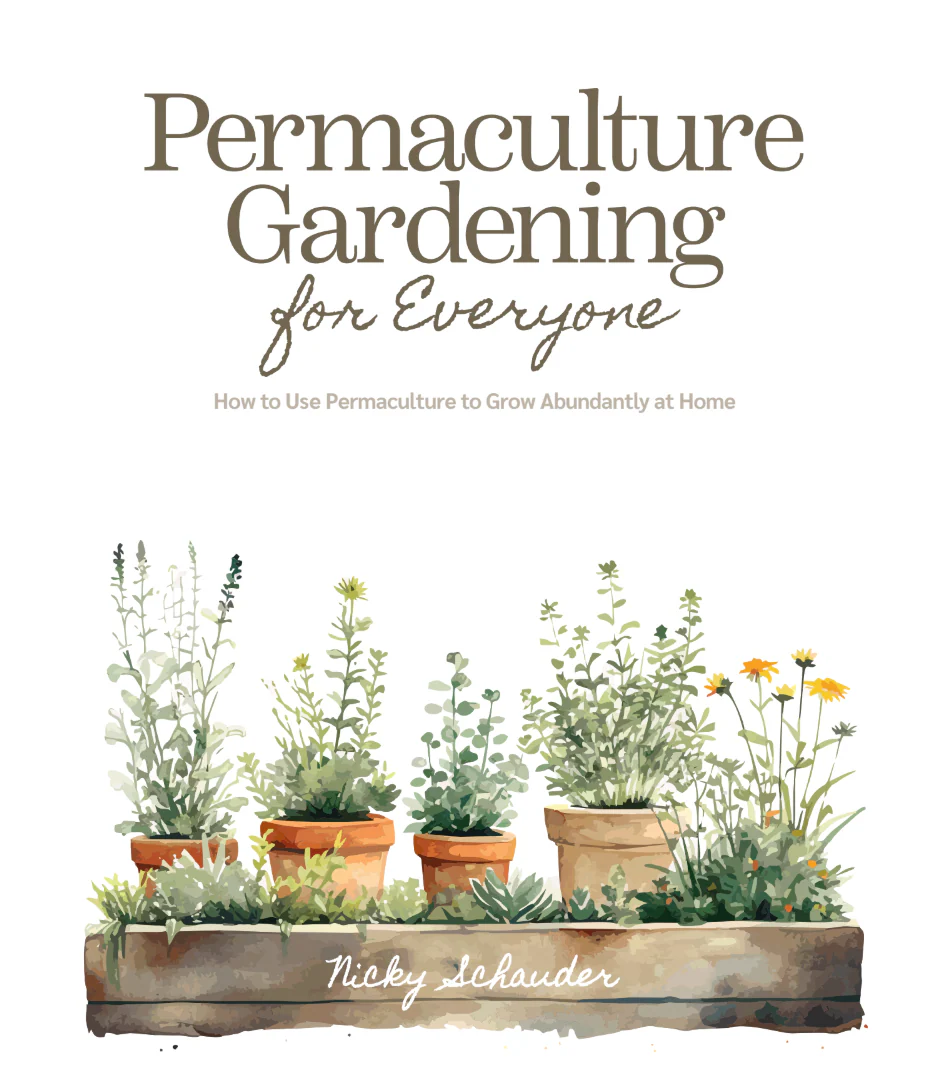
Book Review: Permaculture Gardening for Everyone: How to Use Permaculture to grow Abundantly at Home. Nicky Schauder. Ogden Publications. August 2025. 128 pages, $17.99
This is a beginner vegetable gardening book for those interested in trying some permaculture approaches. It’s a slim, attractive, well-illustrated book, written in a very accessible conversational style, and includes workbook pages. Nicky and her husband Dave have six children, and the first two were diagnosed with severe food allergies to tree nuts, peanuts and fish. They were spurred by this difficulty to grow food for their children that was free of chemicals that could be driving the big increase in food allergies in the US. They chose permaculture because it includes the whole environment around the food.
Permaculture practitioners have contributed to a greener planet, more sustainable living and food abundance. Although Permaculture promotes perennial crops, it recognizes that the bulk of our food crops are annual plants. By focusing on circular, regenerative systems, permaculture design aims to use the end products and byproducts of one process to create new processes that generate new growth and feed the soil. The ethics of permaculture are earth care, people care and fair share.
Permaculture’s cocreator David Holmgren listed 12 principles to constantly practice:
- Observe and interact
- Catch and store energy
- Obtain a yield
- Apply self-regulation and accept feedback
- Use and value renewable resources and service
- Produce no waste
- Design from patterns to details
- Integrate rather than segregate
- Use small and slow solutions
- Use and value diversity
- Use edges and value the marginal
- Creatively use and respond to change
Probably some of these speak to you clearer than others, but all are worth considering.
Nicky starts with a chapter about growing sprouts and microgreens, vegetables you can grow before you set up a garden. Not an obvious place to start permaculture, but a very accessible one. There are clear instructions and a chart of seven popular sprouts, including their germination temperatures, how much seed you need for a 1020 sprouting tray and how long the harvested sprouts will keep in the fridge.
The next chapter is about garden design, and Nicky encourages a practice of 10 minutes of garden observation and journal recording daily for ten days, followed by seven minutes a day “for the rest of your life”. Observe patterns of climate, topography, water, wind, existing vegetation, weeds, wildlife, access and aesthetics. On Day 1, simply observe, reflect and record your observations. On Day 2, notice patterns – patterns happen when two or media converge: water with wind; seeds, petals, sepals in a sunflower head; water running over land. There are practical ways such patterns can be applied. Permaculture has a language of plant guilds and zones. The ideas can be applied even if you don’t adopt that language. The point is to notice and use patterns.
On Day 3, think about zones of use for efficient and sustainable land management. Have things that need daily attention nearest to your house. Work outwards to frequently-used areas, semi-intensive cultivation, occasional visits, minimal care and finally, unmanaged wilderness (a small town garden won’t have much of that). Day 4 is for climate and micro-climate observation. Use forecasts and observations of temperature, precipitation, wind speed and direction at various times of the day. On Day 5 find your microclimates – hot, cool, dry, wet, sheltered.
Day 6 is for observing topography, the curves and contours of your land. Compare your land with a map, and think about where you will put raised beds, a pond or wetland, swales to hold water. Observe locations of power lines and utilities. Day 7 is devoted to water and its management: how can you channel the water where you’d like it to go? If it rains on Day 7 you are lucky: you can directly observe the flows.
Day 8 is for observing where people walk, so you can plan paths and sitting areas, growing areas and storage areas, ensuring everywhere is accessible in the ways you need it to be. Where possible, double up on functions of a space, using tool storage boxes as benches to sit on.
On Day 9 observe the existing vegetation and learn what it is telling you about the previous use of that space, its dampness, soil acidity or compaction. And on Day 10, thoughtfully plan your yard.
Chapter 4 is about choosing your plants. Because plant diversity is important in creating symbiotic relationships and long-term stability in the soil micro-organisms, it is wise to choose vegetables from as many of the 7 common plant families as you can. That’s brassicas (cabbage etc), solanaceae (nightshades), cucurbits (cucumbers, melons, squash), legumes (peas and beans), amaranths (spinach, chard, beets), umbelliferae (carrots, parsley, celery) and alliums (onions, garlic). Nicky recommends also adding something from the mint family and the aster family (lettuce, sunflowers). Also consider perennials. Fit with your climate and the type of soil you have. You could follow John Jeavons and rotate crops between heavy givers (legumes), heavy feeders (tomatoes, squash, brassicas) and light feeders (root crops, spinach, lettuce).
There is a kitchen garden plan to critique, particularly answering whether it needs more diversity. It has a row of 22 yarrow plants, which left me mystified (they’re to deter deer, I found out later). Hardly any actual vegetables (just bunching onions). Strawberries, mint, sage and oregano for culinary use. Seven patches of anise hyssop, a mostly medicinal herb. Eight sunflowers. Lots of apparently empty space. Is it lawn? Bare soil? There are no brassicas, nightshades, cucurbits, legumes or amaranths. Is this a trick quiz, or a worksheet for us to fill out?
There’s a stepwise system for planning which crops to include, looking at what time of year they have the best conditions, then creating a crop template for each of the four quarters of the year, in just one bed at a time. Lay out all your annual garden beds in a diverse and complementary manner, deciding what you want to grow and eat in each quarter. The next step for each bed is to look at which crops might follow after the first season. And if possible, integrate perennials. There are worksheets to help you.
Chapter 5 is on starting seeds. Nicky favors using only 1020 flats and dividing them with twine or tape into 4 sections. This idea works best when the crops sharing a flat like similar germination temperatures and take a similar number of days to emerge. Calculate how many plants you’ll need of each crop, add a buffer and sow that number of seeds. Number of plants needed = average annual amount consumed per person divided by the yield per plant. As soon as one flat is emptied, you can refill it and sow the next “wave” of four crops.
Chapter 6 is on preparing your soil (while your flats of seedlings are germinating!). Nicky recommends taking lots of “before” photos, then inviting a large group of friends and neighbors to “install” your garden, that is, make up the beds and paths. Ahead of that day, prepare a detailed plan of the steps you’ll need to take. The book contains advice on this! Nicky uses a “scrum” board, a wall with rows and columns of sticky notes. The column headings are Backlog/To Do/Doing/Done. Each major project has a column of sticky notes, one for each task within the project, along with how many hours of work it might take, and the tasks must be done in order. Each sticky note gets moved from left to right according to progress.
I got distracted by the description of mortaring bricks into walls. Nicky’s mortar must be rather different from UK mortar. With this kind, you line up the bricks, mix the mortar, let it set overnight, then mortar the bricks, let them set, then put them in place. Be sure you have the right kind of mortar for this method!
Prepare your soil to be in the best possible chemical, physical and biological shape, before you plant anything (especially perennials). Get soil tests, interpret the results and decide on amendments. Set your plants up to achieve maximum photosynthesis, maximum protein synthesis, good lipid synthesis and phytonutrient synthesis, in line with John Kempf’s Plant Health Pyramid.
As well as the chemical composition of the soil, the biology and the physiology of the soil are vitally important. Read up about soil fungi and bacteria (and archaea) and the balance between them. Different plants thrive according to whether the soil is fungal or bacterial dominant, and the pH will be different. Six important soil rules are to limit disturbance, keep the soil covered (with plants), promote diversity of plant and animal species, grow cover crops, integrate animals where appropriate, and work within your climate and geography, and your spiritual, social and economic context. Nicky and husband Dave have a set of four videos for Mother Earth News members: https://www.motherearthnews.com/courses/seasonal-garden-planning/. In the book, there’s a garden installation checklist to help you plan for a group “barn-raising” type of intense garden creation.
Chapter 7 is about transplanting seedlings, carefully explained for beginners, including how to decided if your transplants are ready to go out (Big enough? Needs potting up for a longer stay inside? Do they have two true leaves yet? Do they have enough roots? Are they sufficiently hardened off? Is the outdoor soil warm enough? Have you got the tools you need?)
To help with planning the fall growing season, there’s information on frost tolerance and days to harvest for nine hardy leafy greens, and information on cloches, low tunnels, cold frames, hoop houses and greenhouses.
Chapter 8 covers maintaining your garden: plant supports, mulching, watering, wind protection, pests and diseases. Nicky’s main recommendations for dealing with insect pests are diverse plantings to help the pests get lost; umbellifer plants to attract predatory insects; diatomaceous earth against crawling insects; Beauvaria bassiana (a naturally occurring fungus) as a last resort; borax or neem oil against ants.
Pest mammals are harder to deal with. Nicky suggests fencing, and planting aromatic herbs such as thyme, basil, anise hyssop and yarrow to dissuade deer. You do have to plant a lot for this strategy to work. Good fences, especially double-layer angled fences are the best solution, although motion-sensor lights and water sprays can work.
Weeds are worth studying, to better understand their successful strategies. Identify your weeds, deal with them while they are small, try flaming or solarizing, pull by hand, mulch heavily, and start with crops that are the most competitive with weeds.
Plant diseases are legion, and identification is essential to effective treatment. Nicky is a fan of aerated compost teas, or hydrogen peroxide.
The last chapter is about harvesting, choosing the right time (don’t harvest too soon, or you get less, and it might not taste as good). Sweet potatoes continue to bulk up as long as temperatures remain over 75F. Wait for your cabbages to form firm heads and get your broccoli before the buds open; learn how to recognize ripe melons. Consider recording your harvests as a way of assessing how well you are doing.
Lastly, prepare for your next crop. Start transplants 1-2 months before the expected end of the previous crop. Prioritize establishing the new crop over getting every last morsel from the old crop. Make a planning calendar, tweaking it each year in light of what you observed the previous year.
This book will be valuable to complete beginners, to guide them into producing food, and to doing so effectively and regeneratively. It will help build confidence where that was scarce.