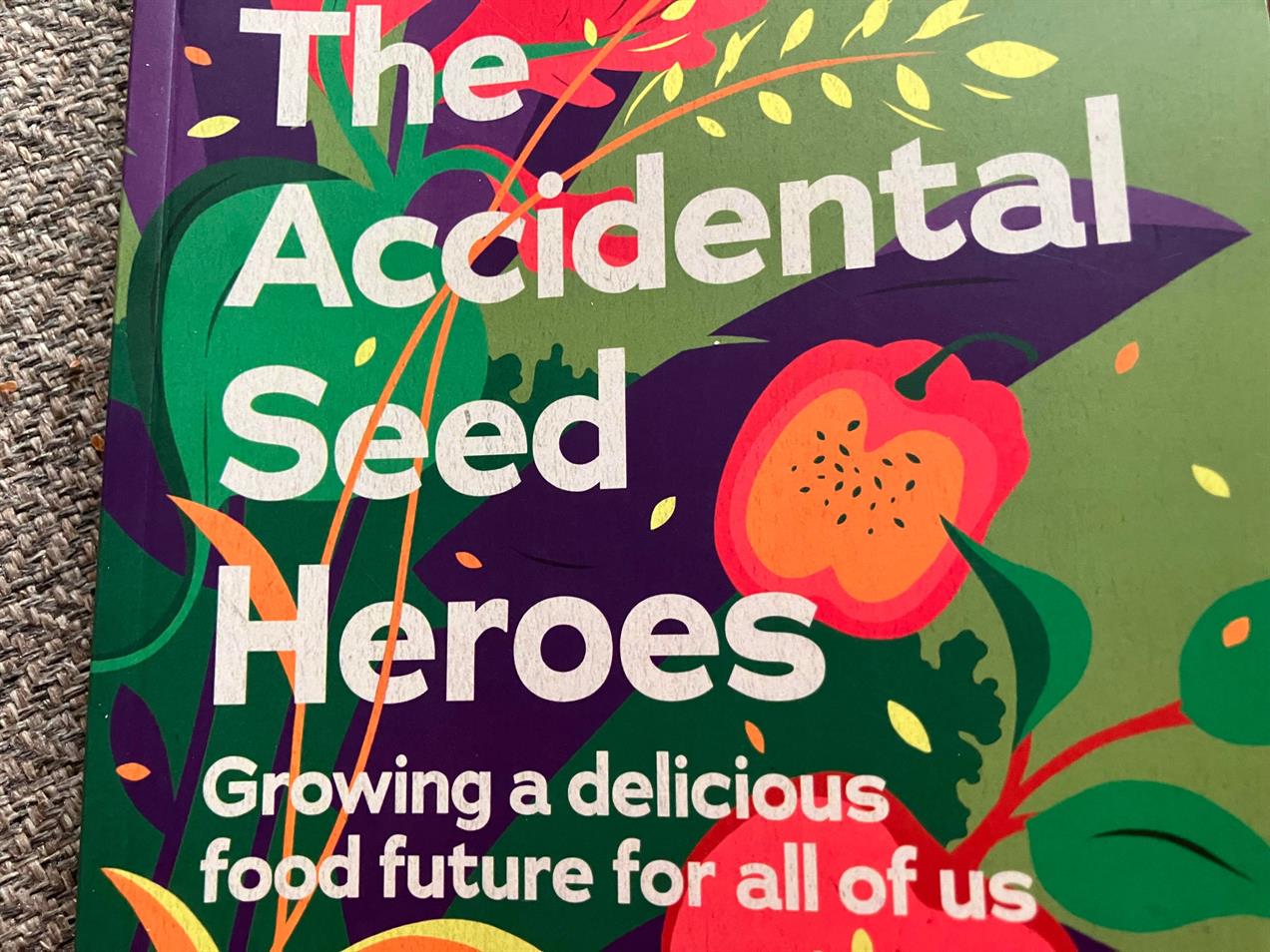
Book Review: The Accidental Seed Heroes: Growing a delicious food future for all of us. Adam Alexander. Chelsea Green. 2025. 128 pages, $29.95US, $40CAN, 20GBP.
By stewarding heritage varieties and breeding wonderful new ones, farmers, plant scientists and gardeners across the world are the seed heroes giving us delicious food that considers our environment and is resilient in the teeth of our changing climate. Adam Alexander brings us absorbing and inspiring stories that give us hope and encouragement for our future, and ideas on how to move forward with providing good food.
This book shows us the big picture of feeding the world and goes in well-explained depth into plant breeding and selection. After reading this book, we can feel pride in our food-growing efforts and encouraged to do more. We will have a renewed respect for seeds and seed growers. The book includes a glossary and chapter notes for those wanting to know more.
This book is a delightful compilation of very readable short chapters that are an engrossing combination of travelogue, food writing, biology, farming and science. The engaging stories of traditional farmers preserving indigenous crops are matched with modern plant-breeding efforts focusing on flavour and sustainability.
This book salutes people who fervently believe seeds should be owned in common, not used to make private profit, and the growers who breed crops that are not dependent on chemical inputs, uniformity and monoculture, particularly those who freely share their seed-breeding work with other breeders.
A “cultivar” is a variety that has been deliberately bred to meet a farming need, while the word “variety” includes plant types that have arisen from accidental crosses and mutations. The two words, however, are often used interchangeably. A landrace, farmers’ or folk variety (FV) is a plant population with a limited range of genetic variations, which is adapted to local agroclimatic conditions and has been generated, selected, named and maintained by local farmers.
Accidental Seed Heroes gives a great explanation of plant breeding, both phenotype breeding (classical, traditional) by hand pollination or mutagenesis (forced mutation), and genotype or molecular breeding, including transgenics (genetic modification) in which genes are transferred from one species into another. Adam does not argue about genetically modified cultivars, but points out that those designed to thwart a specific bug or disease are continuously evolving and are vulnerable to losing their immunity. Also, we don’t need them.
Stories in this book range from indigenous crops like enset, tef and sorghum used in the Global South, and grain mixes known as maslins grown to provide resilience in the face of extreme climate variations, to vegetables and fruits both prosaic and exotic.
The first chapter provides a brief history of plant breeding in Europe, starting at the beginning of the 19th century with Dr John Garton who systematically cross-pollinated thousands of combinations of grain varieties. His first big success was an oat named Abundance, in 1892. John Garton worked for the public good, creating a great diversity of new varieties which spread throughout the British colonies. Garton offered to donate his whole body of work, with seeds available free (or at market price) to farmers. The ag board turned down his offer, and for 85 years, Gartons Limited sold his seeds.
In the US from 1843, US Navy ships collected plants and seeds across the world for the benefit of American farmers. The seeds were distributed free. Newly arrived immigrant farmers were very happy to develop the wheat varieties they knew from their home countries.
Newly created open-pollinated varieties were sold or given away. Both publicly funded bodies and independent research groups founded gene banks with thousands of varieties of every type of crop, making their work available to all who requested it, with no strings attached. This proliferation of crop development continued until the discovery of genetics in the early twentieth century led to plant patents.
In the UK, the Plant Breeding Institute and the National Institute of Agricultural Botany (NIAB) were established 1912-1919. F1 hybrids were developed by selecting pure lines of plants with specific traits and then crossing them, resulting in cultivars that were better than their parents. These public institutions were privatized by the Thatcher government in 1987, and later sold to Unilever, Monsanto, and RAGT (associated with Bayer).
The next theft of the common wealth of seed germplasm was to grant patents to seeds and treat them like intellectual property. The International Union for the Protection of New Varieties of Plants (UPOV) was established in 1961 and now has 79 member countries. Four criteria are used to determine if a variety can be patented: novelty, distinctiveness, uniformity and stability. The rules of patents say that conventional breeding employing essential biological processes cannot be patented, but agribusinesses have succeeded in receiving patents, due to varying interpretations of the rules.
Patents impede small-scale plant breeders from building a sustainable food production future. The author has a lot of information here about Intellectual Property (IP) rights, Plant Breeders’ Rights (PBR) and growers’ rights. Just 5 seed companies control over 40% of seeds sold worldwide. 6,995 seed companies own an average of 0.008% each.
Albania and Ethiopia are two countries offering insights and examples of sustainable ways to feed ourselves, thanks to the genius and persistence of farmers. Ethiopia’s climate varies from arid desert to tropical and subtropical arable land with large rivers, and mountains up to 3,000 meters high. Ethiopia is home to a huge diversity of domesticated crops, and one of Africa’s oldest and largest seed banks, working with over 30 local community seed banks. Farmers borrow seeds and after harvest, return the amount they borrowed, plus a little more.
This “conservation through use” provides security by decentralizing the seed supply and adapting varieties to the changing climate. 90% of agriculture in Ethiopia grows such “Farmer Varieties” of crops. The Ethiopian Biodiversity Institute (EBI) holds germplasm of 90,000 varieties of edible and medicinal plants. Some is stored in the Global Seed Vault in Svalbard, Norway.
One of Ethiopia’s most important indigenous crops is enset (Ensete ventricosum), commonly known as the false banana. Ethiopia is the only country to have domesticated this valuable carbohydrate crop. The stem and root are fermented and ground to make porridge, bread and pancakes. The fibers are used as a packing material and to make rope. Enset is propagated clonally, and provided the rate of harvesting is sustainable, it is a wonderful insurance crop.
Albania has a wide diversity of plants and is the last of the Balkan states to introduce hybrid cultivars. Until 1990, the system of collective farms enabled Albania to feed itself sufficiently, if not well. After the collapse of communism, the land was reallocated to individual families, with an average holding of 1.4 hectares (2 acres), and the country continues to grow almost all the food it needs. In the last 30 years, farmers have moved away from growing and saving seeds, and Albania now imports 80% of its seeds. Traditional seed varieties are rapidly being lost.
Adam devotes a chapter to bread, wheat and other cereals. There has been a myth that good wheat for bread baking can’t be grown in the UK or most of the US; that northern climates with cold winters are needed. Adam discovered Hen Gymro (“Old Welsh”), a Welsh Farmers’ Variety of wheat that is wonderful for bread baking. It grows and yields well in what could be seen as unpromising conditions and produces long straw good for thatching.
Wheat started its evolution in the Fertile Crescent, (eastern Mediterranean). Wild grasses were the ancestors of emmer and einkorn. Wheat is special in containing many glutenins, which help create good stretchable stable doughs.
Sorghum was domesticated in Sudan 5000 years ago. It is one of the world’s most important cereals, and there are about 25 species native to Africa. Three other grasses: maize, wheat and rice, provide 50% of the calories consumed in the world.
The 1930s US Dust Bowl saw farms turn to dust because of eight drought years following many years of poor land management. Dryland Farming methods for growing with less rainfall and irrigation were ignored: pasture rather than arable farming; attention to healthy soil rather than extracting water for irrigation and using fertilizers to get high yields; diverse crops rather than monocropping which is vulnerable to disastrous diseases.
Climate change is likely to drastically reduce global maize yields (due to higher temperatures), but increase wheat yields due to higher CO2 levels. Crops bred to succeed in low-input systems will most likely do better than homogeneous cultivars.
Tef is a super cereal, fast-growing, viable at elevations of 0-3000 meters, used to bake the fermented flatbread injera, eaten daily in Ethiopia.
Hunter-gatherers could avoid famine by finding different plants to eat. Domestication reduced options, increasing the risk of starvation. Many gardeners and farmers practice some kind of “insurance-growing”: hardier kale to eat if the weather is awful and the preferred kale doesn’t do well; chard for hot weather leafy greens.
Included in Farmers’ Varieties of cereals are maslins, which are mixtures of different grains (sometimes including legumes) grown together. These provide greater resilience against pests, diseases, droughts and floods than varieties grown separately. When wheat and barley are grown together, in drought the barley survives. In good years, wheat does better and yields more than barley. This is insurance against bad outcomes.
Diverse heterogeneous seed mixtures (evolutionary populations and cultivated land races) have greater resistance to pests and diseases and are therefore more valuable to farmers. They adapt to changing environments in just five years. They can be traded at seed swaps, but not publicly sold in the US, because they don’t meet stringent government requirements. Encouragingly many farmers and growers are working locally to increase and improve crops that can do well under organic and regenerative agriculture.
Next, we move on to beans. In the UK, canned baked beans provide ubiquitous quick meals. The bean used is the small white haricot, also known as the navy bean. Ironically, this bean does not grow well in the UK climate! 50,000 metric tons are imported annually, mostly from the US, to just one Heinz factory in Wigan. There, 3 million cans are produced each day. Another supplier, Princes, in Lincolnshire, produces 0.72 million cans per day.
In the UK there is a big move to develop more beans for the chilly damp cloudy climate. In 2023 Princes pioneered a conventionally-bred British-grown bean, Capulet, and is expanding the acreage of that variety. 43% of the UK population eats beans-on-toast at least once a week.
Capsicums are next. Really hot peppers have their enthusiasts, although I am not one of them. If you are, you’ll enjoy reading about the hundred chili pepper varieties grown at Sea Spring Seeds in an interesting method involving no deliberate crossing. They have keen eyes for spotting improvements and saving seed from those plants.
Sweet bell peppers are grown in California on a huge scale for winter harvest. These hybrids are harvested in just a few passes over the fields, demonstrating a classically fragile food system. This crop needs about 5 gallons of water per pepper, and is being grown in a desert, with water extracted from the Colorado River and declining aquifers.
Tomatoes grown in Rajasthan, India use various colors of shade cloth to moderate the extreme range of temperatures there. 50% green shade was working best at the farm Adam visited. That area gets very little rainfall and over-extraction of ground water using tube wells was causing the salinity of the water to increase. Finding crops that can cope with high-salt conditions is a modern-day challenge.
Adam’s visit to Austria led to the Awesome Emma tomato, bred by two amateur seed breeders to thrive outdoors in a low-input system, such as organic farming, in the foothills of the Alps. Awesome Emma is descended from Bianca (a small pale yellow cherry) and Stripes of Yore (bred by the American who brought us Green Zebra). The fruits are purple and gold cherries with a complex flavor, and a tasty balance of sweetness and acidity.
A network of professional plant breeders (the Bauernparadeiser-Projekt) across Austria, Germany and Switzerland is developing new tomato cultivars resistant to late blight (Phytophthora infestans) which thrives in high humidity and rainfall. Most of the blight-resistant varieties are hybrids, but in Hessen, Germany a company is selling a diversity of blight-resistant OPs.
Hybrids offer uniformity, reliability, high yields and sometimes great flavor. A good example is the much-loved Sungold cherry tomato. Cultivars like this lend themselves well to efforts to develop an OP strain, and many growers are doing just that.
“Dehybridising”, or growing F2s and their offspring using classical breeding methods, has proved to be a successful strategy for freelance breeders to develop new lines. I do not like the word “dehybridizing” as there is really no going back or “undoing” involved. It’s more a matter of using the plant’s genetics to create something new, closely resembling the desired fruit.
Adam investigated the creation of Mango Lassi, a delicious red cherry tomato, developed by Vital Seeds in the UK from 25 plants of Sakura cherry, which is a great starting point. From the F2 generation of 25 plants they carefully selected for flavor, growing habit and other traits. From the best six plants they saved their F3 seeds and grew another 25-plant generation. They took seed from the best four plants, which had fruit with some mango flavor, and started selling Mango Lassi.
The next chapter is about breeding pea seed, particularly Honest Ærling’s Genuine Eating Pea. The name sounds better in Danish: Æliger Ærlings Ærgte Æde Ært. Adam already had his own favorite pea, Avi Juan, which he wrote about in his earlier book The Seed Detective. Other well-loved pea cultivars include Winterkefe, a tall tasty mangetout or snow pea with some winterhardiness for early spring harvest, maintained in Switzerland by ProSpecieRara.
Sugar snap peas originated with an accidental mutation found in an Idaho pea field, bred with Mammoth Melting Sugar to have larger, straighter, tender pods of sweet fat peas. After eight years Sugar Snap was ready for sale.
Sweden is stricter on pesticide use than many other countries. Pea researchers in Sweden have worked to find resistance to downy mildew and pea root rot. Breeding for resistance to multiple diseases is hard because it can reduce flavor and yield. When stable resistance can be bred in, the cultivar can continue to be used for many years. Most Birds Eye pea cultivars have been grown for 25 years!
Frozen peas are very important these days. Invented by Clarence Birdseye, Birds Eye went on to become a business model bringing together farmers and breeders in the pursuit of quality. All Birds Eye peas have the recessive rr gene (wrinkle-seeded) which creates peas with twice as much sucrose as RR (smooth-seeded) peas.
In the UK, Birds Eye buys its peas from The Green Pea Company, a cooperative of 250 growers, all within a short drive of a freezer plant so the peas get frozen promptly after harvest. Birds Eye contracts with the coop and covers the harvesting costs, while the coop covers the risk of poor yields, and other bad luck.
We want peas sweet, but greens can be tasty and healthy when bitter. Bitter compounds serve the plant by deterring insect pests. The bitter compounds in brassicas are glucosinolates. When our gut microbiome interacts with these compounds, highly bioactive compounds form and help our liver and kidneys remove toxins. Cooked broccoli is better than raw in this cleanup task. Lettuce plants, when stressed by drought, heat or old age, can produce excess milky sap (latex) containing bitter sesquiterpene lactones. Some bitter plants such as hemlock are very poisonous. We need to discern which are good for us, and which not!
The next chapter is about eggplants/aubergines, which, 300 years ago, were creamy-white and goose-egg sized. In their homeland of India, 2,500 varieties of eggplant grow in hugely diverse climates. Despite this, there is no guarantee that there is an eggplant for every climate! Gardeners in cool climates find this a challenging crop.
Seed breeders are challenged because eggplants are parthenocarpic – they set fruit without pollination. Growers, however, benefit from this trait, as a decent yield is achievable even when conditions are wrong for pollination! Commercial breeders have little incentive to develop strains for marginal climates. Fortunately there are growers who rise to the challenge.
Søren Holt in Denmark has a shady, wet, windy garden. He started with Applegreen, and other varieties that flourish in cool climates with a short growing season. He pondered how to overcome the self-fertilizing habit that made cross-pollination rather unlikely. He had promising results with Skorospely, Rima and Almaz (Black Diamond), developing a locally adapted Danish Farmer Variety. After three years, he had three breeding lines of F3 plants, including one that gave high yields of large eggplants. But few seeds!
There could be a paradigm shift in plant breeding, to improve biodiversity, food security and human health, and to sequester more carbon than produced. This will take a lot of work, both in persuading people to take that path, and in breeding suitable food crops. In Andhra Pradesh, in the rice bowl of India, the regional government has set up a goal for the entire state to grow food agroecologically. With one million farmers enrolled, they have achieved an 11% increase in productivity and almost a 50% increase in income, using sustainable farming methods, as well as improving social cohesion and wellbeing.
Adam firmly believes that future generations will look back on the 21st century as the time when agricultural sanity was restored. Everyone who grows food and saves seeds is on the right side of history! Open-source plant breeding empowers all seed growers to be part of building resilience and sustainability into our food system.