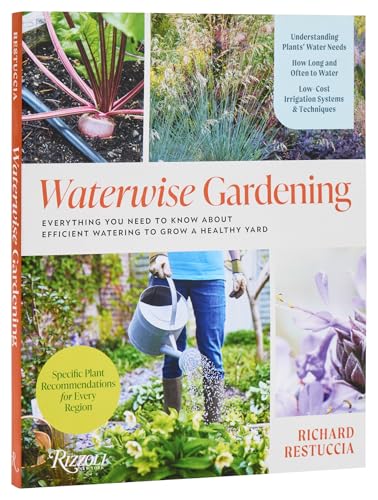
Book Review: Waterwise Gardening: Everything You Need to Know About Efficient Watering to Grow a Healthy Yard. Richard Restuccia. Rizzoli International Publications, Inc, New York, 2025. 240 pages, USD $29.95, CAD $40.00 paperback.
This is a book for home gardeners who want to grow productive healthy plants, both food plants and landscape plants, while wasting less water. Richard Restuccia hails from La Jolla, San Diego, Southern California, and has needed to become proficient in conserving water. The author has provided specific information for gardeners in Southern and Northern California, the Pacific Northwest, the Desert Southwest, the Rockies, Texas, the Southeast and the Northwest. He has also gathered general information on plant water needs and watering methods so that home gardeners do not have to search multiple websites and publications. As well as saving 30%-50% on water bills, this book can save gardeners time, frustration, and money replacing dead plants.
The EPA estimates that home gardeners waste 50% of the water they apply, from ignorance. This book aims to remove any ignorance and fill the gap with practical detailed help. Learn how to study your soil and install affordable watering systems and smart controllers that automatically adjust daily watering based on soil moisture, real-time weather forecasts, and the author’s charts of species-specific water needs. You can start without the automated smart controllers, of course, especially if you learn how to tell if your plants are underwatered or overwatered. Yes, both misjudgments can cause wilting!
This book is printed in China on heavy, high-clay coated paper. The paper does have a FSC Mix certificate, FSC C104723. It doesn’t appear very ecological, but I haven’t researched thoroughly. The book has large attractive photos, often without captions, rendering them less useful. I tried not to let these shortcomings put me off from appreciating the content, which I know can be hard for gardeners and even professional growers to find when starting out.
The chapters cover soil health, predicting plants’ water needs, understanding regional water needs, figuring out how often and how long to water. Next up are chapters on distinguishing between underwatering and overwatering, avoiding overfertilizing, fine-tuning irrigation systems and fixing problems, following drip irrigation best practices, and understanding smart water controllers.
We all need to work together to solve water scarcity issues. This is a social justice issue, requiring the more privileged to sacrifice some of their good fortune, so that everyone can have enough. First we need to understand seven common causes of water scarcity.
- Drought: some areas no longer receive reliable rainfall. We need to prepare to manage with less water.
- Population growth: people moving to popular locations increase the local demand for water, which needs to be planned for.
- Climate chaos includes increasingly unpredictable weather. We need better water storage systems for the heavier (but less frequent) rainfall.
- Water pollution: higher population densities, more industries and unsustainable farming practices lead to worse water pollution. We all need to reduce contaminants.
- Inefficient water use: inefficient irrigation systems, and wasteful domestic water use. Technology can help us be smarter about how we use water.
- Aging infrastructure: leaky water supply lines waste 50% of the US water supply, according to a 2020 Stanford study.
- Over-extraction of ground water: pumping out groundwater at a rate greater than water tables can replenish it clearly needs to stop. Older agricultural irrigation systems use a lot more water than drip irrigation systems, for example.
The Earth contains the same amount of water today as it ever has. Water molecules cycle round and round. No new water has been created. The uses of water have increased. (Nuclear power plants! Data centers!) The increasing world population (7 billion today! 10 billion by 2099?) uses lots of water to produce food. Already, a quarter of the world’s population does not have access to safe drinking water. Remember, a person can survive for only about 3 days without water. It’s not only about industrial and agricultural uses, but also about how long we each spend in the shower, the shower-head flow rate and the toilet flush volume. And how we irrigate our gardens, fields and landscapes.
This book chiefly covers backyard flower gardens, lawns and landscapes. Almost 50 pages provide thumbnail photos and tips for flowers and shrubs. There are other books, such as Steve Soloman’s Waterwise Gardening, addressing vegetable growers, and Dale Strickler’s Drought Resilient Farm, which includes livestock farming.
While hoping for the best, we can plan for the worst. From 2015-2018, the 4 million residents of Cape Town, South Africa were limited to 13 gallons of water each per day, because water crisis officials chose an over-optimistic approach and were unprepared for changing weather patterns. In the US, the average water use is 100 gallons/person/day. We need to do everything within our power to conserve water. For growers and farmers, this starts with understanding our soil. Different soil types have different water-holding capacities. I have a sandy clay loam which this book tells me can hold 1.8”- 2.0” of water, a pretty good amount.
You can send a soil sample for assessment, or you can use the simple tests described by Richard Restuccia: the ball and ribbon test, and the jar test, accompanied by the triangle diagram of soil types that you have likely seen before. You can get soil tests to show pH and mineral composition, helping you understand how to have a healthy well-balanced soil that makes best use of available water. A percolation test will tell you how much you need to water your soil type and how long to water for each time. There are step-by-step instructions and an explanation of what to aim for, balancing the soil saturation point (no space for air in the soil), the field capacity (the happy point of moistness), the permanent wilting point of your crops (the water in the soil is not enough for the plants to pull up) and the oven-dry soil (no water left in the soil). Between field capacity and the permanent wilting point lies the range of workable depletion. The goal for irrigation is to give a plant the same amount of water each time, bringing it up to field capacity, then waiting close to wilting before watering again. The frequency of watering will change according to prevailing conditions. This method keeps your plants healthy and productive, while avoiding overwatering.
Waterwise Gardening includes information not commonly found in books for home gardeners: water cycling via evapotranspiration. Eleven factors are explained, suggestions on where to find the data are provided, and Smart Irrigation Controllers ($85-200) are advocated for. These can quickly pay for themselves on metered city water, and can help everyone get better yields. They are linked to weather stations, and let you customize your irrigation. Larger systems have irrigation tracking software that estimate evapotranspiration. Some screen shots of one controller are shown, and predictions are growing more accurate as AI is employed.
A rule-of thumb tool (mostly specific to California, although applicable elsewhere) is the Water Use Classification of Landscape Species, which can be combined with crop selection, and a “crop coefficient” method, to improve water management. Crop coefficients relate the water use of a specific crop at early, mid and late-stage growth to that of a reference crop such as grass. Naturally this is simpler for commodity crop farmers to calculate than for vegetable growers with many different crops, but it can help to group crops with similar water needs in the same zone. (If you are not already maxed-out with considering crop rotations, cover crop options, and soil prep considerations.)
There is a water-use table for popular farm crops, giving relative water needs at various growth stages, and also final root depth. This is followed by 50 pages of information on flower species and shrubs, grasses and groundcovers, biased towards California, and including other coastal and southern regions.
The next chapter covers how long and how often to water. The best use of water for healthy plants is to water them the same amount each time you water and change the intervals between watering to suit the conditions. This is the best fit way to ensure plants always have all the water they can use. Fill the water-holding capacity of the soil in the plants’ root zone. No more, no less. During cooler and rainier periods, water less often, only when needed.
In terms of distribution uniformity, spray heads are 50% efficient, rotors 70%, rotation nozzles 72%, drip irrigation 90%, and point-source drip emitters 93%. You can plan to move towards more efficient irrigation equipment if you are not already using the best gear. With overhead irrigation, much evaporates before it can reach the soil. Another aspect of irrigation is the precipitation rate, the speed at which the water arrives at the plants.
Application efficiency is the percentage of water applied that is actually used by the plants. It measures how effectively the system delivers water to the crop and how well the water is used by the crop, taking account of at least five factors. The book runs through example calculations comparing the time per week to irrigate a crop with sprinklers and with drip irrigation. (About half as long with drip.)
Once you have calculated the total run time in the week, decide how to divide this over the seven days. This depends on several considerations, such as the soil’s water capacity. Sandy soils drain quickly and may require more frequent smaller waterings. Climate, weather, plant type, irrigation system type, and other factors may affect your decisions. Keep in mind the goal of deeper watering less frequently. Monitor how the crop responds to your decision and adjust if needed.
Homeowners as well as farmers need to be more active in water use management. A 20% reduction in landscape water use (not commercial farming!) in California would be equivalent to never using water to flush toilets (in California, I assume). The book includes advanced irrigation calculations, for those who have capacity beyond the basics. Or those with a greater need or commitment to water conservation. The author suggests that Smart Water Controllers can remove the overwhelming nature of lots of calculations. For those on metered water, a smart water controller can reduce water bills by 30-50% and quickly pay for itself.
Smart controllers adjust irrigation schedules based on soil conditions, evapotranspiration rates that day and real-time local weather data, and can include several customized zones depending on the water needs of crops in each zone. They can also detect and alert you to leaks. Smart controllers can use wifi or cellular connections. Each has advantages and disadvantages (listed in the book) depending on location and personal preference.
The next chapter gives help determining whether you are overwatering or underwatering (or watering just right!). When plants look unhealthy, there is a human tendency to give them more water and/or fertilizer. Wilting can be a sign both of underwatering and overwatering! If soil is saturated for some time, plants can starve of air and even die. Roots can rot, depriving plants of nutrients, and ironically, water!
There are ten signs of overwatering:
- Wilting even though you have supplied plenty of water: If the upper leaves are wilting more than the lower ones, leaf texture is limp and soft, and soil is moist or soggy, you are overwatering. If the lower leaves are wilting more than the newer leaves, this is likely to be caused by underwatering.
- Brown leaf tips: When more water arrives at the leaf tips than they can use or transpire, the cells burst and tissue dies.
- Whole leaves turn brown and wilt: If the brown leaves feel crispy, you may have underwatered. But if they are limp, you overwatered, causing a shortage of oxygen.
- Leaf edema: Blisters and pale warty growths on the leaves are a response to cells bursting from excess water. This doesn’t happen with underwatering.
- Yellowing leaves with stunted growth, due to root suffocation affecting the plant’s ability to take up enough nutrients: Inability to take up sufficient iron leads to a shortage of chlorophyll, hence yellowing leaves. Yellowing can also happen with underwatering, but in such cases the leaves turn yellow in patches, not uniformly, and yellowing moves up the plant from the lowest leaves.
- Leaf drop: Consider whether the leaf loss is a normal seasonal change or not. Monitor the growth of new leaves. If new leaves are healthy and sufficient, don’t worry about leaf drop. Leaf drop caused by underwatering produces crispy fallen leaves, and the soil will feel dry.
- Moldy soil may indicate an imbalance of soil microflora caused by overwatering or poor drainage. Some molds indicate plant diseases, some produce mycotoxins that inhibit growth of seeds, plants or animals. Dense mats of fungi (such as slime molds) and also algae on the soil surface can inhibit gas exchange, reducing oxygen in the soil. Cultivate the soil surface and allow soil to dry out slightly before watering again.
- Mushy stems may be a result of overwatering (or mechanical damage, disease or pests). Pruning out the damage and improving air circulation helps.
- Fungus gnats are often associated with overwatering. The larvae thrive in moist conditions, feeding on plant roots, weakening them. They also transmit diseases between plants. Reduce watering, increase airflow and use yellow sticky traps.
- Slower growth than normal. Check plant height, leaf number and size, and internode length. Underwatering can also cause slow growth, as can poor light and cool temperatures.
The next chapter addresses possible overfertilization and “fertilizer burn” from excesses of salts in the fertilizers. Organic gardeners are much less likely to have this problem because natural fertilizers usually contain lower levels of salts and compost releases nutrients gradually. However, concentrated organic fertilizers can cause this problem too. If your fertilizer comes in a packet, follow the dose instructions. Over-fertilization causes symptoms that resemble both overwatering and underwatering: curling leaves, leaf browning, stunted growth. If the soil does not seem over-wet, try watering and watch what happens.
A chapter on simple adjustments to finetune the irrigation system you have comes next. First understand your system, where to turn it off in emergency, and how to adjust the settings for different results. A “wet check” (while the system is watering) assesses any problems with basic function and distribution. Inspect each part, looking for leaks, uneven distribution, clogged nozzles or emitters, water pressure problems and runoff or erosion issues.
Wet spots may indicate leaks or simply low spots where water gathers, given the opportunity. They may indicate water is still draining from your system when it should be off. Check the meter or use a stethoscope to listen for water running. There may be a broken pipe, a popped-apart component or a leaky valve. Carry a bucket of spare parts, tape and tools when you explore for leaks. Sometimes you can save a lot of water from a leaking hose connection by replacing the hose washer, or at least turning it over to get a better seal.
Understand the nozzles on your sprayers. Adjust them as needed, or switch them out if you discover you have the wrong type. Websites and chat boxes can be very helpful.
Check that spray nozzles provide the spray pattern and intensity you expect. Clean out clogged nozzles. Try making fine adjustments while the water is running, for immediate feedback. Adjust the spray distance (radius of watered area), the shape of the watered area (full or part circle) and the direction of rotation, which can affect the radius watered.
Drip irrigation systems use the minimum water needed for your plants. Check that everything is running as it should be. Check the water supply rate and the pressure regulator. Clean the filter on the mainline. Don’t mix tape emitter spacings or flow rates if you want even watering. Ensure the number of lines is optimal for your crop and your soil (from calculation or past experience). Count or measure the number of emitters in each zone and make sure you do not exceed (by much) the number the system can provide for. Look for leaks, kinked tubing or tapes, fixing problems as you go. After an irrigation event, walk the area and check that the soil along the tapes seems evenly watered, and that the soil between each neighboring pair of tapes (for close-planted crops, not for widely spaced rows of big plants) is damp at finger depth.
Next are more details on how to fix some common irrigation issues, with a few photos. This covers pop-up rotor sprinkler spray heads, including how to manage runoff caused by sloping ground, and then drip irrigation, mostly of the micro-tubing sort. The book closes with an appendix of winter-hardiness zones in the USDA system, RHS (UK) and Australian zones, useful websites and (new to me), the Penman-Monteith Equation for calculating evapotranspiration using meteorological measurements with grass evapotranspiration as the reference. Looks complicated, but is highly accurate. It enables an estimate of the rate of water loss, and therefore the water requirement.
Summing up, here is a book written in a water-scarce environment to help growers and landscapers figure out how much water their plants need and provide just that, not a drop more, not a drop wasted. Meantime, those in moister climates can use some of the information to perfect their irrigation systems and schedules. Probably all of us can use the chapters on overwatering and underwatering and how to tell the difference.