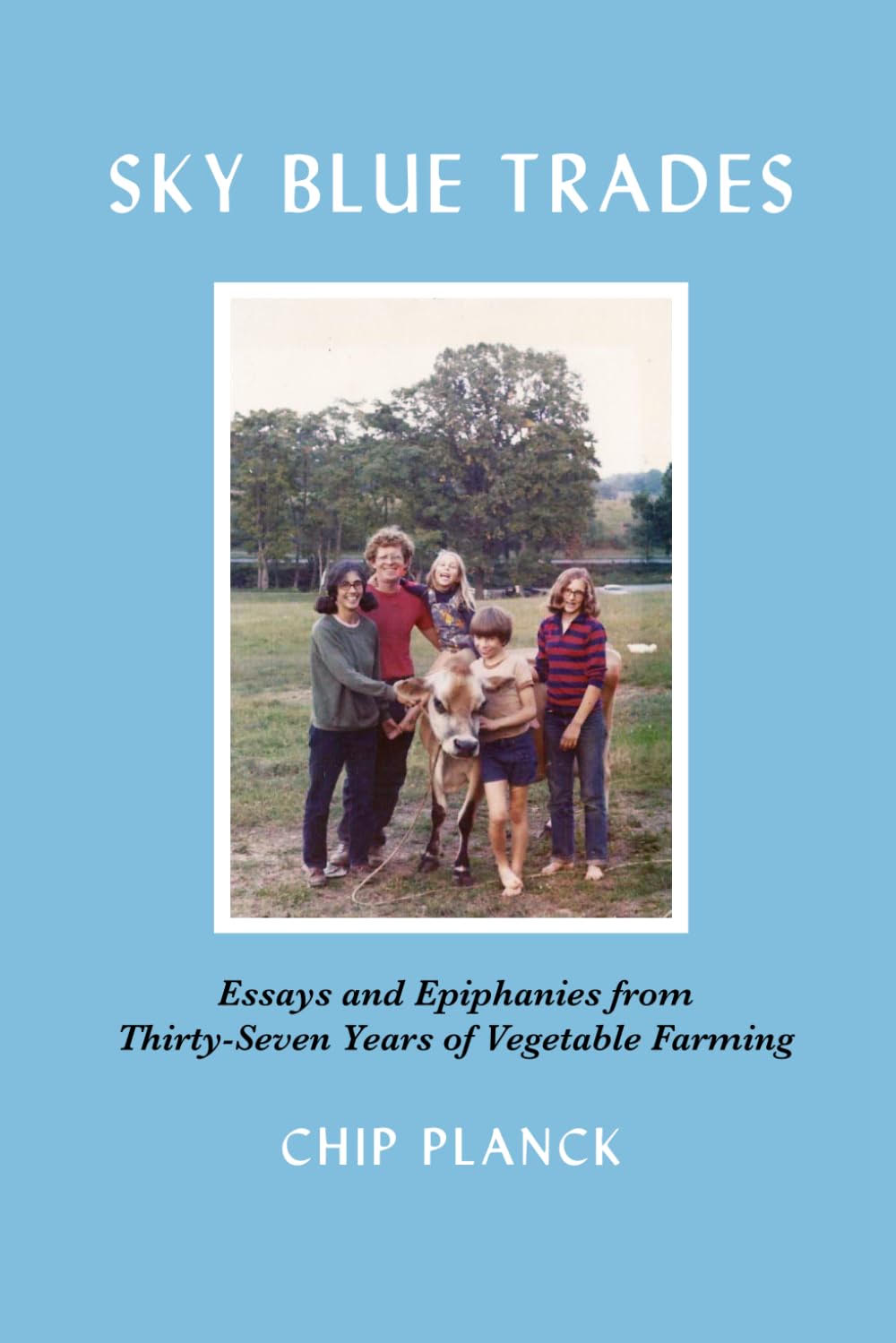
There are sections on money, customers, workers, politics, the neighborhood, and, bravely, their
low points. Poetry by Chip and a summation by Susan round out the book.
Chip tells how in 1973, a group land purchase of 400 acres 50 miles NW of Washington DC
bought him and Susan a 60 acre share of that land, with a house in poor repair and the treasure of
learning from Tony and Hiu Newcomb of Potomac Vegetable Farms, who also co-signed their
loans. After 5 years as junior partners to Hiu and Tony, they began their own Wheatland
Vegetable Farms, and marketed initially at roadside stands, but found insufficient traffic. They
switched to driving in every week to 10-15 farmers markets in DC and the suburbs, and ran the
markets from 1979-2010, growing 20 acres of vegetables. Clearly they needed a good supply of
workers to pick and sell all that food.
Susan and Chip were successful full-time vegetable farmers for 37 years, without going to ag
college, and without outside jobs or government payments. Their business covered retirement
funds as well as farm expenses and daily living. They worked hard, read a lot about farming and
picked up every tip they could from their mentors.
They paid wages, saved for retirement, planted enough crops, worked enough markets. And
didn’t take off-farm jobs. In dollars per hour, the wages to first year workers were close to the
Virginia minimum wage. Wages went up by $1/hr for second year workers, and another dollar
for third year workers. Extra was paid before and after the academic vacations, and to those who
stayed to the end of their contract. Returning workers were about one third of the crew. Yes, they
kept precise time sheets, paid employer’s share of Medicaid and taxes. It was important to the
Plancks to provide their workers’ contributions to retirement. They also provided spartan
housing and plenty of produce. They are not owners who enjoy working endless hours in
isolation.
They tracked their earnings in five-year rolling averages, to allow for the widely changing
seasons. Their peak years were 2001-2005, after 20 years of learning, and before starting to cut
back on acreage and markets as part of their gradual retirement planq. In their last 4 years their
net earnings were higher because they had dropped their weakest markets and hired fewer
workers.
The year was mentally divided into three parts: 7 months frost-free of “overtime weeks” (7 days
of 10 hours each), 2 months of “full-time weeks” (7 days of 6 hours), and 3 months of part-time
work (7 days of 3 hours). That totals 2750 hours a year, compared to a standard work year of
2000 hours.
Farming occupies a humble economic sector. In their first five years, the Plancks each made
$1.85/hour, compared to $20/hour during the peak fat years. At one point they reached the top
10%, and then the top 4% of farms as far as earnings went. Lots of labor and smart decisions
produced lots of earnings. Not quite as good as it sounds maybe, as 50% of farms have sales of
$10,000 or less. Many are part-time.
The overall picture is that they made enough to raise and educate a family, stay healthy, pay off a
mortgage, and save for retirement. Working at home is nice except when you can’t get away.
Working outdoors is refreshing except when it’s awful. Farming can leave you feeling well-used
or used-up. You might feel like a glorified amateur or a thwarted specialist. But -ah- you can
choose and enjoy your work.
The book also includes amusing insightful sections, such as the one on “conference brain-death”,
the unforeseen side-effects of what farmers hope will be an energizing break: being denied true
rest.
The Management Made Easy chapter includes Wheatland Vegetable Farms Fourteen Principles
of Effective Worker Management. Useful stuff. Hiring workers increases production, income and
happiness. Hiring family members might not, because you will be living with them at day’s end,
and may hear about your poor decisions and grumpy behavior over dinner.
Refusing to hire workers because you can work faster than them is like a teacher complaining
that students don’t know anything. Why are you teaching? The net return from the workers is the
important bit, not who is fastest. It’s the volume of beans picked that generates the income.
One person alone cannot generate enough picked beans to raise a family. Thoreau was subsidized
by Emerson paying for his hut. Don’t wait to get big before hiring workers. Hiring them will
enable your farm to expand.
Do forewarn new workers of the realities of the job. Wheatland provided applicants with a 10-
page description of the farm and the Plancks’ approaches to work and the reasons for the
growing choices they made. They updated it each year. Unlikely fits selected themselves out.
This saved hours of meeting time.
Every new task needs to be shown and then checked three times, starting half an hour into the
job. Pull out rejects from the picking basket and point out missed crop that should have been
picked. Don’t let people start a task until they’ve watched and listened. (Chip says to handcuff
the crew until you finish the explanation.) Start with the statement that any mistakes you are
warning them about are ones you have made yourselves. Quality control is a continuous job.
This year, this week won’t be exactly the same as the last one.
Working with your crew gives the best collective result. People working in small groups of
mixed abilities raises the overall result. Assign the people to a group. Choose the best workers
for the specialized crops. Keep things flowing. Avoid letting crews grind to a complete halt.
Move some of them on to another task, allocate clean up.
Experience of school life does not teach personal efficiency or co-operative work skills. Don’t
expect college kids to have developed such skills. Farm workers need to understand picking and
selling, as one skill informs the other. The farmer has to let go enough for workers to be sloppy
and inattentive at first. The market customers will give the workers feedback. You can give them
meticulous instructions and build trust.
Pay them, reward them, retain them, join them in fun as well as work. You will be building a
network of future farmers – 25 workers out of 300 Wheatland workers went on to farm
commercially. What makes a good worker? A good employer.
Workers can form a tribe, a small community. They talk about work over their dinners. This
spreads the norms, practices of the farm and gives them a chance to compare with other farms
any of them have worked at.
At Wheatland, there were no financial secrets. The Plancks told the workers what they made and
spent on the farm and trusted them to take produce to market, sell it and bring the money home.
Many farmers try to keep the workforce to a minimum, but Wheatland chose the other path.
There’s a chapter on why it’s valuable to have some less-efficient workers and some less-
productive acres, so long as those workers and acres generate a net return. The workers enjoy
having others around, and when the going is hard, they appreciate having other people to share
the difficulties, or at least get the picking done faster and get in out of the rain. Over 25 years,
evidence mounted that more labor could earn the farm more money. During their first 5 years,
Chip and Susan kept 16 cents of every dollar in sales. Labor was 30% of total costs. Later the
margin grew to 34 cents of every dollar earned and labor was 49% of total costs. Other costs
shrank to less significance compared to labor.
In their last 4 years of farming, 2006-2010, they cut back a lot on acres cultivated and markets
served. Labor decreased to 34% of costs. Work became more efficient but was insufficient for
the owners to live off. They started to draw Social Security and retirement savings, which was all
part of their plan.
If the customers wanted small tomatoes, pinks, unusual types, they did their best to meet their
requests. That took a lot of labor. Note, however, that growing 12 types of tomatoes is all
“growing tomatoes” – the same skill set.
How many workers are too many? Life is a perpetual trade-off between favoring and cultivating
skill and efficiency on the one hand, and encouraging maximum participation and learning on the
other hand. Each season, the 10-20 workers started out trying all tasks. Group cohesion makes
for better results than sub-dividing, leaving only all the slowest to pick tomatoes, where none of
them would improve. Getting the job done correctly and quickly is vital to success. In some
situations, giving a task to the best suited pays off, but never assume.
In the early 1990s, Loudon County adopted a hamlet ordinance, a kind of cluster housing idea.
Each rural building lot had to be big enough to include its own water and sewage facilities, be set
back from the road and be part of a clustered arrangement that included some common open
space and left some surrounding land undeveloped under the residents’ control.
In 2002, they started to develop a hamlet, with a contractor digging perc-test pits. After this very
speedy start, it took 15 years before the first house and lot were sold. Houses of modest square-
footage, built for maximum solar gain, from high quality materials, oriented to encourage
neighborliness, with 96% of the farmland in a conservation easement preventing more housing
being built there. There are two large “Conservancy” lots owned by farmers and 7 householders
on small building lots. Rural growth without sprawl, or much loss of farmland.
In the US, consumers were responsible for starting producer-only farmers’ markets. Farmers
answered the demand, bringing produce close to where large numbers of people shopped, and a
new movement flourished. This worked better than roadside stands (not enough customers),
dealing with wholesalers (inflexible demands, late payments) and hobby farmers (selling small
volumes unreliably).
Farmers’ markets had low entry barriers (a patch, a truck, a card table, some produce) and no-
selling-before-the-bell rules (self-interested cooperation). Selfish unregulated behavior (the
tragedy of the commons) was avoided.
The section telling three serious Low Points of life on the farm is presented as cautionary tales
and lessons learned. Farmers should not take risks with machinery, should fess up, pay up, and
know when to give up on trying to fix broken machines. Appreciate your local rescue squad.
Don’t blame fate for effects of your errors, or your inattention. Follow standard safety
procedures. Only do dangerous work with someone else nearby, appreciating your local
community. Learn from your mistakes. Death will happen. Have a plan for caring for your dead,
burying them, gathering friends, mourning them, celebrating their life, keeping mementoes,
including some of their writing, art or craft, and arranging for farm life to continue while you are
doing these things.
Chip’s poems are easy to read, encapsulating the wisdom and wonder of farming. Not many
books include an ode to groundhogs, grasshoppers, crickets, mice and slugs! Thes poems are
good to read when you have only two minutes and need a pick-me-up.
Oh, the book has no index! Sad omission, as I’m sure others will want to read parts more than
once.
There’s an appendix for busy readers, by Susan. History, methods used on their farm to replenish
the soil, include cover crops and hay mulch, sow and transplant, manage pests including weeds,
insects, diseases (baking soda works as well as two commercial fungicides for hay-mulched
musk melons, plastic mulch prevents splash-back fungal problems). They bought only used
equipment, including several tractors and a bean picking machine. The buildings included their
house, a large bank barn (worker housing, equipment storage and chickens).
They added hoop houses, a workshop, a worker kitchen, a seasonal bath house, a greenhouse.
They built crates and pallets, developed a fast system for filling flats with medium. They used a
scale to weigh filled flats and determine if they held enough water (a method for new people
until they got the hang of what the correct weight felt like.) Seven foot deer fencing around their
60 acres became essential once their neighbors at Potomac Vegetable Farms had fenced their 400
acres.
Mulch is valuable stuff. On 20 or 25 acres, the Planks roll out 5”-6” of low-grade hay from 500-
700 pound round bales, paying $10-$12 each. This saves a lot of cultivation and adds organic
matter to the soil, while storing rain and preventing run-off erosion. There are more advantages
listed.
After trying many crops, they eliminated peas, snap peas, potatoes, broccoli, cauliflower,
cabbage, celery, kale, collards, leeks, fennel, sweet potatoes, rhubarb, strawberries and
raspberries. They focused on multiple successions and multiple varieties of the crops that did
best for them and that customers wanted. They chose good-flavored varieties.
They settled on a uniform price per pound for squash, cukes, eggplants and onions, to make
check out easier. Their lettuce was entirely Batavian Summer Crisp types that do well in spring,
summer and fall, entirely grown from transplants germinated in the basement. The transplants
were popped into plastic mulched beds, hooped and covered until saleable, then cut 2” above the
ground for two weeks of regrowth. The cut leaves were washed, mixed and bagged. Direct-
seeded greens were sown in mid-August, again in mid-September, in broadcast patches.
Work shifts were 8-12, 2-6, or when very hot, 8-12 and 3-7 or 7-11 and 3-7. Each worker (not
Susan and Chip) had one day off per week (staggered and excluding market days of Friday and
Saturday). Everyone went to market two days a week. They paid their middle and high school
children at worker rates.
In retirement, Chip and Susan have 1/10 acre vegetables on landscape fabric. And they have
written this book.
https://www.amazon.com/dp/B0GNKQDL58?lv=shuf&language=he&channelId=500&plpRedir
ect=mhFallback $13[/vc_column_text][/vc_column][/vc_row]