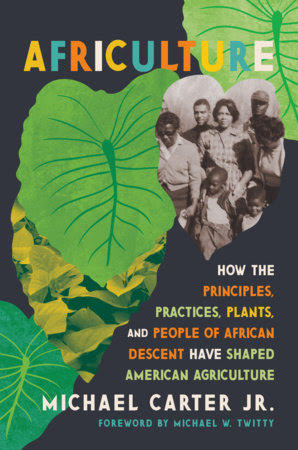
Book Review: Africulture: How the Principles, Practices, Plants and People of African
Descent have Shaped Agriculture by Michael Carter Jr. Chelsea Green, 2026. 308 pages,
$22.95 US, $40.00 CAN, 22.95 GBP.
As a fellow Virginian, I am honored to offer praise for Michael Carter’s new book, Africulture. I
enjoyed his account of his family’s farming history. Mr. Carter shares five generations of Black
farming experience and reminds those of us who need reminding, that without African farming
experience, white immigrants like me would not have survived long in the American colonies.
With inspiring bios of prominent Black farmers and educators, Africulture presents an uplifting
message and encouragement to other farmers, especially Black farmers. I value Mr Carter's work
to preserve civil rights, and his determination to raise awareness of the painful history of Black
people in the US, including segregation, Jim Crow, lynching and resistance. I learned a lot more
Black history from reading this book. I’m not including it in this review as I imagine many of
you already know a lot more than I do about that.
Mr Carter tells us: “The average age of a farmer in Virginia is fifty-nine, but for Black farmers
it’s sixty-three. Between 2017 and 2022, Virginia lost 10 percent of its farmers and 20 percent of
its Black farmers. The state is losing Black producers at a higher rate than any other
demographic.”
“The amount of land lost by Black farmers and families in the last sixty years is, I dare say, a sin
to our ancestors who made it their sole mission to acquire land between 1865 and 1965. I’m a
benefactor of my ancestors’ efforts and I refuse to let go of what was sacrificed by my
grandfather and his brothers with their World War II checks.”
He writes in a very lively, readable style, using stages of plant growth: Seeds, Soil, Roots,
Compost, Leaves, True Leaves, Pestilence and Resistance (plants and people), Flowering, Fruit
as metaphors of Black farming history. His work includes Principles of Africulture, using limited
inputs: reuse materials your farm provides, properly dispose of whatever waste ends up on your
hands; use sustainable organic practices, co-operate on marketing and training, and strengthen
future generations of Black farmers.
The Carter Family in Ghana
Michael Carter and his immediate family spent 5 years living and working in west African
countries, especially Ghana, 2012-2017, before returning to his family’s farm in Virginia. Living
in Ghana changed the Carter family’s perspective. The Carters were regarded factually, as
obroni, people from the horizon, or white men. Skin color was not seen as the major identifier,
but foreignness was.
Vegetables and fruits were bought fresh daily, and cooking dinner required full attention,
dedication and love. There were lots of leafy greens, including Nigerian spinach (Celosia
argentea), gboma (Solanum macrocarpon) (the g is silent), Alefe (Amaranthus cruentus),
nkotomere (cocoyam leaf/taro leaf /elephant ear, Colocasia esculenta), water leaf/boko
boko/fame flower (Talinum paniculatum) and ayoyo/jute leaf (Corchorus olitorius), which I
wrote about in June 2025 as Molokhia (pronounced “mo-lo-HEY-ah”), Egyptian Spinach.
The Ghanaians have a very well-developed understanding of the medicinal value of plants.
Food Crops from Africa
From May to September the Virginia climate is like the rainy season in West Africa. I appreciate
the descriptions of tasty African crops that might be useful in central Virginia for climate change
resilience. To grow Ghanaian crops, we need to choose those with shorter growing cycles. Our
season is too short for the tree crops or annuals needing 6-9 hot months to maturity.
Virginia can grow amaranth, Nigerian spinach, managu, molokhia, okra, sorghum, millet and
cocoyam, all sown in the continental US after Mothers’ Day, the second weekend in May. Soil
temperatures should be 70°F-75°F (21°C-24°C). Their roots grow deep, enabling them to be
drought tolerant, and helping provide more trace minerals. A bonus is that deer don’t seem to
like these greens.
Several African greens also have ornamental relatives, but the green-leaved versions are
preferred for eating. I don’t know why. The greens need to be stewed well over a high heat with
palm oil and egusi (seeds of specific melons). Taro tubers and leaves need careful cooking.
“Two African crops—sweet potato greens and Nigerian spinach—contain some of the same
nutrients as kale, but they are dependent more on the fungal network to supply their nutrient
needs. Their content of manganese and some other micronutrients is higher than that of kale.”
Clif Slade says, on selling the leaves of sweet potato plants: “You can talk about doubling your
money. . . There’s $20,000 per acre in the [sweet potato] leaves with the right market, and eating
them can help control blood pressure. Large amounts of sweet potato leaves can be fed to
livestock. And at Virginia Tech, they’re pelletizing the stems and feeding tilapia.”
First Leaves
The “First Leaves” chapter has information on rice, cotton, indigo, peanuts, cocoa, vanilla,
coffee, honey and kola, and several leading Black farmers. It was here I learned more about my
“sweet potato hero” Dr George Washington Carver. I immigrated from a climate too cold to grow
sweet potatoes, so I knew nothing. This was pre-internet, and I was thrilled to find a photocopy
of Dr Carver’s 1936 publication “How the Farmer Can Save His Sweet Potatoes, and [32] Ways
of Preparing Them for The Table.” I had not understood properly how to cure sweet potatoes
before storing them. Gratitude to Dr Carver! Dr Carver was even more famous for his work with
peanuts. Did you know that boiling peanuts preserves them for several days without
refrigeration?
Dr Carver also designed a mobile demonstration lab called the Jessop Wagon, which was used to
take information out to remote rural areas of Alabama and provide information for farmers. He
wrote “It has always been the one ideal of my life to be of the greatest good to the greatest
number of my people possible, and to this end I have been preparing myself for these many
years, feeling as I do that this line of education is the key.”
Dr Booker T Washington was born into slavery in 1854 and walked 500 miles to enroll in the
Hampton Institute in SE Virginia at the age of 16. His dedication to education, community
building and Pan-Africanism was huge. Dr Washington became the first principal of Tuskegee
University in Alabama, where the students and local community hand built the collage, including
making the bricks, sewing their own sheets and growing their own food.
Dr W E B Du Bois wanted the Talented Tenth, the most capable Black students, to receive the
best education and so serve as a think tank and group of leaders for the Black community. He is
more widely known as a highbrow intellectual rather than a rural pragmatist like Dr Carver and
Dr Washington. Later he developed a wider understanding of the needs of Black farmers.
Mr Tetteh Quarshie, a Ghanaian blacksmith, established the commercial cocoa industry in Ghana
in 1879, and export began in the 1890s. Cocoa is native to central America, and became
cultivated in Africa, especially Ghana, in the early-mid-1800s.
Vanilla was much coveted by the Europeans, who had no success getting it to grow. 300 years
later, someone figured out that a very specific pollinating bee that was only found in Mexico was
needed. The French shipped seeds to their colonies off the coast of Africa, Réunion and
Mauritius. 21 years later, a 12-year-old enslaved African boy, Edmond Albius, used hand
pollination, smashing the anther sac and stigma together between his fingers, solving the
problem.
Watermelon was one of the best cash crops for Black farmers in the South, easy to grow, easy to
transport, kept well in its skin. This superfood is a great hydrator and a nutritional powerhouse.
But watermelon was heavily denigrated as poor people’s food, and disrespected, cast as bad,
backward, food for country bumpkins.
Our Genes are Made of What our Ancestors Ate.
African crops grown in American soil by enslaved Africans with African expertise helped
sustain the colonizing immigrants. Our bodies are made of the food we eat. Our lineage reflects
the foods of our ancestors, which may have come from other continents.
Three quarters of the British colony of Jamestown died of disease and malnutrition between
1609-1610, despite eating rats, snakes and their own dead neighbors. They had refused to follow
local foodways, instead trying to grow cool weather UK crops. White settlers in 1619, when the
white population had been reduced to 12% of its size, decided they would need to enslave Black
people to grow their food. Some of the enslaved people arrived with leftover food stores, and the
African crops grew well in the SE US, but in the Midwest, 50 years of soil mismanagement led
to the Dust Bowl. Ignorance and greed destroyed 6 feet (2m) of topsoil.
Racial Equity
Equity is not just about perceived treatment but includes discussions and ideas around shared
ownership and control of resources. White European men have determined what resources they
want and how to get them and control them. Financial equity is the value of an asset after the
cost (debts, liabilities) have been subtracted. Equity depends on ownership and is a store of
financial value. Social equity (including racial equity) is defined as justice, fairness and
impartiality. It’s also a store of value for people, ownership in communities, controlling resources
(not necessarily owning).
Black people sometimes risk their jobs, homes, freedom, even their lives, when dealing with
white people. White people need to face being outside their comfort zone, to become educated in
other cultures. This book seeks to improve people’s racial literacy around the bigger history of
agriculture. Buy from local Black farmers and local Black businesses, and other enterprises of
people of color.
The Fruits of the Ancestors, Legacy and the Future
Fruit is both the fulfillment of the plant’s growth and the container of the seeds to start the cycle
again. A responsibility and a survival instinct. Plants share resources in the soil. When someone
asks for help, try to give them a hand. Mr Carter gives space in his book for soil brothers and soil
sisters.
Carter Farms and the Africulture non-profit
The Carter Farms land, purchased in 1910, was almost lost near the end of the 1920s, when it
was used as collateral on a $636.40 debt. The stock market crash of 1929 meant the borrowers
could not repay the cash. Of the ten siblings in that generation, Mrs Mattie Shirley Carter Pryor,
one of the youngest, great-grandmother to Michael Carter Jr, was the key person who saved the
land.
Michael Carter Jr went to North Carolina Agricultural and Technical State University, an HBCU,
where students were encouraged towards employment in the USDA or the agriculture industry,
not to be farmers. Carter was not interested in being a farmer. He was more interested in his
minor, fashion design. It was many years before he regained his connection to the land.
When Mr Carter and his family returned from Ghana in 2017, he combined a job at the Virginia
State University Small Farms Outreach program with selling African vegetables to restaurants.
He established the non-profit Africulture to focus on “the principles, practices, plants and people
of African descent that have contributed to agriculture.
From Carter Farms in Orange County, Virginia, Michael Carter, Jr provides technical farming
assistance, events and workshops on growing and marketing African and other specialty
vegetables. The land around Carter Farms became an epicenter of Black landownership and
cooperative economics, farmers helping each other buy land.
“Africulture became an official nonprofit in 2020. Small farmers found themselves in a unique
situation that spring because of COVID-19. Small farmers across the country became a
lifesaving force for families and communities, setting up farmers markets and driveway stands
where customers could come and pick up produce, proteins, and value-added products during a
time when entering a grocery store felt dangerous.”
Carter says “I wanted to use the Africulture platform to promote connections on many different
levels. The African ideal that everything is connected always resonated with me, a stark contrast
to the siloed, isolated, subjective thinking in most of the West. The connections among music,
food, soil, agriculture, literature, meta- and quantum physics, nutrition, and mental health maybe
aren’t normally seen, but they are made clear to me through my Africultural lens.”
Africulture appendices include a timeline of African agriculture, incorporating that of the Carter
family, some of whom arrived in the first generation of exiled Europeans reaching the US; a
Carter Family Tree, with African, European and Native American roots; and a table of nutrient
levels in crops at Carter Farms. There are chapter notes and a selected bibliography, and a 17-
page index. There are 16 pages of color photos and several archival B&W images are seeded
throughout.
More information
Michael Carter Jr has taught a course on Africulture at the University of Virginia.
The Black Family Land Trust (BFLT) based in Raleigh, NC, works as a conservation
land trust, to keep Black families on their land in Virginia and several other states. “The
Sixth Love Language – A Will.” Putting land in a family land trust can save a family from
fighting. The Uniform Partition of Heirs Property Act 2020 helps prevent involuntary
loss of family land.
Visit the Black Farmers Index (blackfarmersindex.com), the largest, FREE, most
comprehensive directory of Black Farmers. The Index connects you to traditional and
non-traditional growers, from row crop farmers, ranchers, vegetable and fruit producers
to beekeepers, fisherfolk, foragers, vintners & more. There are 12 regional groups.
For those in Virginia, there’s also the virginiablackfarmerdirectory.com.
Celebrate National Farmers’ Day in the US on October 12.
The Happily Natural Day Festival in Richmond, Virginia, is on Saturday Aug 29, 2026