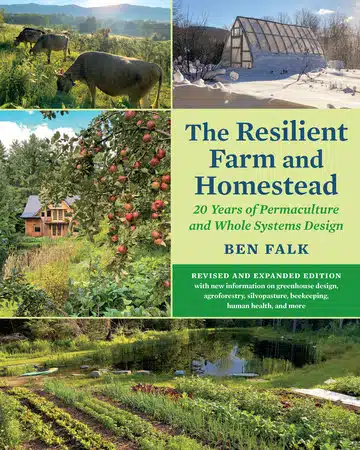
Book Review: The Resilient Farm and Homestead: 20 Years of Permaculture and Whole
Systems Design. Ben Falk. Chelsea Green. Revised and Expanded Edition, 2024. 342 pages,
$44.95 US, 40G BP.
Ten years after writing the first edition of his book, Ben Falk has made a revised and expanded
edition with new information on greenhouse design, agroforestry, silvopasture, beekeeping,
human health and more. Even more valuable are his further ten years of experience feeding his
thoughts and practice of permaculture in a cold Vermont climate, no-till farming, native versus
introduced plants and insects, vegan versus livestock-included farming, dealing with climate
change and living a whole life. He was a single, physically fit, energetic and slightly idealistic,
25-year-old when he landed on his 10-acre homestead in 2003, and 35 when he wrote his first
book, encouraging readers to “Be bold and try stuff.” After another ten years, he has a partner
and a son, a lot of lived experience with various agricultural theories, a realization that his first
decade was the “establishment phase,” a career in professional land use design, and
determination to live a balanced life. His gained wisdom shines through.
Ben has the courage to tackle his earlier ideas and those of other agricultural writers and speakers
and say what did not work for him and what does. You can be confident that his suggestions are
practical and efficient, as well as resilient. The beautiful photos show ideas in action, not merely
under construction as some permaculture publications do. Rice paddies in Vermont, possible but
sensible? Swale-enclosed ponds, lovely.
The book includes chapters on creating a legacy in a time of change, design and site
establishment, water and earthworks, fertility harvesting and cycling, food crops, adaptive fuel
and shelter, resilience and regeneration for the long haul. There are useful appendices, including
an aptitude quiz on living a resilient lifestyle, a skill list for emergencies, a curriculum for a
resilient homestead, a checklist of tools and materials, a vulnerability checklist, and a glossary, a
resource list, chapter notes and a thorough index. The introduction lists 20 new ingredients in
this revised edition (including a list of 30 common cold climate site design and building
mistakes); 16 practices they have stopped since his first book (spraying compost tea takes too
much time and shows little result); and 10 new practices they have adopted (grazing cows).
Farming and ecological living can appeal to people across the political spectrum, but Ben does
not shy away from briefly mentioning the current threats of economic, social and environmental
collapse, while addressing vulnerabilities and how we might respond. This is not a “doom-
reading” book, but an encouraging and very practical one! “If we steer Earth towards adaptive
regeneration, we’ll see true resilience much sooner than by just letting it develop ‘naturally’.”
This book uses permaculture design and its framework for problem-solving and refers to numeric
zones within a location. This is concisely explained, so don’t let the word deter you if you are
new to permaculture. Ben Falk has not unquestioningly adopted that cause, or the Green Dream
(personal ecological consumerism regardless of lack of fundamental political change) but
thoughtfully tested and applied ideas that work and don’t cause problems elsewhere in the world.
Ben advocates for people becoming producers rather than merely “less-bad “consumers.
The chapter on design and site establishment is best read before you decide which piece of land
to buy. This is the time to consider your mission, goals, analysis of what’s possible, and how you
plan to do that. To make your land use design, analyze what’s available, consider your options
and implement your decisions, (aka think-design-do-reflect-redesign) as many times in a
repeating cycle as you need to. Likely you’ll have more ideas for tweaking the system than you
have energy for, so you’ll need to prioritize the adjustments that will have the most effect. This
ensures maximum regeneration of land for minimum energy and time input. Ben lists his top five
leverage points: swale construction and use, grazing animals, broadcasting seed and
transplanting, cutting and clearing trees, scraping and tillage to create bare soil.
We need crops that convert the most sunshine and rainfall into usable food. More nut trees, for
example, and intensive rotational grazing. Much of the cold-temperate climate landscape would
be most productive converted to permanent silvopasture. Sometimes fossil fuel use to develop a
site sooner is very worthwhile. Examples include chain saws, earthmovers, electric power tools.
Resilience is the ability of a system to recover from disturbances. Factors include Diversity,
Redundancy, Connectivity and Manageability. Efficiency is not the same as Resiliency. The
“whole world” picture needs to be included, and adapting to changing conditions must be built
in. Actions that increase both biodiversity and biomass increase the ability to be regenerative.
No single design works for all sites or all groups of people. Your own skills and aptitudes are
your most dependable asset. Practice welcoming adversity (the blessing of disillusionment), as a
chance to learn and grow stronger. Try to avoid tight attachments to your goals, as this can lead
to big struggles. Check out popular notions that others have already found faulty: planting
marginally-hardy perennial plants beside bodies of water does not keep them warmer in winter!
Your climate is not the same as information from ten years ago would have you believe! Keep
your own weather records. Likewise, observe whether some practices you don’t believe in –
dowsing for example – do in fact work. Modify your design to balance theoretical “best” practice
with practicality: perfectly on-contour plantings slow, spread and sink water best, but they make
mowing and harvesting harder.
Once you have your land, assess it in some detail before taking any firm direction. Work with the
realities of your land, rather than planning to radically change them. You may see a better plan
emerging. Good designs incorporate the ability to change. Using modular designs makes this
easier. For example, consistent bed and path sizes.
Swales are on-contour ridges made by ditching along contours and piling the soil below the
ditch, helping even out the water supply and retaining water that would have run off the surface
as much as 20ft downhill. Swales make great places to plant hedges, and the space between one
swale and the next makes a good small paddock for intensive rotational grazing.
Only the importation of fertility from other parts of the world has enabled chemical farming to
continue after the Great Soil Erosion of the nineteenth and twentieth centuries. When this
becomes no longer tenable, will we turn to regenerative farming, or let society collapse? We can
save farming by building and conserving topsoil.
When we make compost we need to investigate the source and the content of the materials: What
feedstock was given to the Organic livestock that provides the manure? Was it from lab rats with
a diet of antibiotics or worse? Grasses take up PFAS, such as those in flexible plastic sheeting.
But if not contaminated, they can be a key nitrogen resource. Are roadside leaves safe? Pond
weeds, comfrey, burlap bags, cover crops and organic mulches all have their advocates, Human
urine benefits plants. Humanure is possible if the household doesn’t use pharmaceutical drugs.
Biochar can increase soil water retention, reduce nutrient leaching and encourage diverse micro-
organisms, but poorly made biochar can stunt plant growth spectacularly.
Wood chips are great, but wood chippers are expensive to own and operate and a pain to use.
(One colleague said to me, “Lots of money, lots of noise, lots of gasoline, lots of time, lots of
logs and branches. Small pile of chips.”)
Remineralization is the replacement of missing or deficient minerals, which could be factors
limiting crop health. The Soil Food Web is an approach that focuses on soil biological activity as
the main limiting factor in crop health.
Livestock has an important role for resilient homesteads. Regenerative high density stocking
with very short periods of grazing in each paddock (called intensive tall-grass grazing or mob
stocking ) is very productive and builds soil. Tall grasses (having deep roots) are grazed down to
within a foot of the ground (not all the way down). Some roots die back once they are no longer
needed. As the tops quickly grow back, more roots grow, and soils build. Active management
produces much healthier soil than neglect does. Anyone wanting to restore a neglected field area
can read what not to do, and what to do, in this chapter. Ben’s approach included sheep,
prescribed burns, scything, and over-seeding for several years. But no tilling or plowing.
There are benefits to mowing in some circumstances, with correct timing and severity. Stem
density increases and grasses are promoted. If the existing plants have been cut down enough by
grazers or machinery, May and June are the windows for lightly reseeding. Never let a field lie
fallow for more than a year. Water management will help reclamation. Mow early and often.
Consider permanent fencing. Plan tree plantings in straight rows to make fencing and mowing
easy. Refrain from pruning off lower branches if you plan to have livestock, as that will deter
browsing. Feed hay to cattle on pasture if needed. If you don’t want to raise animals, you need to
mulch or mow the understory of your trees and perennial vegetables. Those tasks take a lot more
labor than raising livestock.
Ducks and chickens, sheep and cows all have their niche. Ben found sheep to be more work than
cows, and both to be quite an emotional and logistical commitment. Sheep are prone to many
diseases, but have a role as smaller, short-term livestock, practical on a smaller homestead.
Ducks eat slugs, forage actively, are cold-hardy and have low health maintenance needs. They
are good layers, and good mothers, have good predator-awareness, and generally won’t fly away.
Don’t believe all the generalizations you might hear about livestock, species, varieties or even
individual animals. Ben reports that his ducks never ate mature vegetation during the growing
season, for 3 years. In year 4 they attacked the cabbages. Who knows why? It was a dry,
relatively slugless summer, which might have contributed. Observe what is true of your animals
this year, but don’t depend on the same thing happening next year. Do believe that chickens will
scratch up your seedlings and new transplants!
Keyline plowing is favored by many permaculturists. It was developed in the drylands of eastern
Australia and may not translate to moister climates. It doesn’t work well in New England, for
example. It may be useful in cold climates (where weather and soil conditions combine to move
water across the soil, rather than into it) if drought conditions prevail. Managed small ephemeral
ponds can capture and hold heavy rainfall.
In-ground septic systems have leach fields capable of supporting good crop yields, of either
cover crops or food crops. Plants cannot move bacteria or other organic pathogens through their
tissues, so there is no danger of E. coli in tomatoes grown above your leach field. Plants can,
however, bioaccumulate heavy metals and other inorganic compounds. If in doubt, test the
plants. Research 2020-2023 suggests plants tend to accumulate PFAs as well as toxins in their
vegetative parts, rather than their fruits and seeds.
Chapter 5 moves us on to details of food crops. Long ago, Polynesians navigated the Pacific in
their canoes, locating small pieces of land to settle. They took with them 24 special “canoe
plants”. These included foods, medicines, fiber and dye plants, building materials and ceremonial
plants. They carried plants gathered from a wide area of the world, to adapt to many situations.
Alongside the benefits of perennial crops, there are some disadvantages. Climate weirdness
brings changes to frost dates that kill blossoms and pollinators, and can affect chilling hours and
flowering dates. One harvest per year from the space the crop occupies can be less than short
term multi-cropping annuals provide. Establishment of perennials can take years (so grow some
annuals around new perennials for the first few years).
People with short growing seasons would do well to grow lots of storage crops, and all of us are
advised to grow a wide range of diverse crops. The book has tables of perennial crops best suited
to various extremes of weather, Goldilocks crops to try out on a small scale, if at all, and those
that give high yields.
For simplicity, focus on larger quantities of more-reliable long-storing foods rather than lots of
small-quantity foods (but keep that crop diversity in mind!). Although Ben’s family used to grow
paddy rice, they no longer do so, due to challenges of aquatic weeds, and losses to birds.
Especially focus on summer-planted late fall harvests, to preserve food for the Hungry Gap from
March to whenever it warms up enough to produce spring harvests. Another option is fermented
storable foods like krauts and kimchi, which take less work than canning.
Ben has a very interesting essay on “Native to When? “Invasive” Species, Species-ism, and
Optimization” that really got me thinking. Healthy ecosystems include high diversity. Humans
are part of the ecosystem (not kings or tyrants, but participants). We intend to manage our
gardens and farmland in a responsible right-action kind of way. Not merely sit back admiring the
view while elsewhere forests are razed to grow soybeans to feed us and our livestock.
Permaculture views plants and other organisms that have been in place for 10 or 100 or 300 years
as not fundamentally more natural or proper than recent arrivals. More important is to consider
what the plant does and how it affects the soil and other organisms, and our needs in that space.
Plants, animals and other humans are not regarded as evil aliens.
Permaculture seeks inclusion and synergy, with adaptation to challenges that arise. This includes
a high level of biodiversity, embracing the legacy of food systems from across the globe. It is not
modeled on what the ecosystem looked like on the North American landmass in 1491, or before
native peoples managed the land to promote chestnut and oak forests, or before mass migrations
of buffalo or any other date.
Some conservationists seem perversely focused on getting back to specific species and
ecosystem arrangements from an idealized past time, even if this involves large inputs of fossil
fuels, chemicals, labor and money.
We are unwise to adopt a “Nativist War-on-Alien-Invader” ideology. During the time that
humans have been moving around the Earth, we have moved around plants and animals (and
associated microbes). What year could be chosen as a starting point to determine whether a plant
is native or alien? We have potatoes from South America, corn from Mesoamerica, honeybees
and earthworms from Europe, apples from Southwest Asia, and much more. Choosing European
contact as a starting date is a prejudice that ignores previous centuries of land management.
No living thing is permanent. Plant successions and ecosystem change are natural. Native white
pine and goldenrod have forced out numerous species across New England. A human moving a
plant from one area to another is no more unnatural than a bird moving seeds. Movement of
species is part of biodiversity. It is our responsibility to determine if it would be helpful to
redistribute a particular species, considering the needs of other humans and other forms of life.
Ben says (and I strongly agree) “Feeding oneself from a monoculture in Iowa or Mexico while
devoting time to spraying Japanese knotweed with toxic chemicals will not get us where we need
to be.” Attempting to maintain the world around us in a static condition is simply not an option.
We now need to provide for 8 billion humans. Hunting and gathering is no longer viable for
most. We cannot live as people did when the Earth was more thinly populated.
Worries about invasive alien species may also indicate a fear that nature will “take over”, and
even a belief that humans are separate from nature, perhaps its masters, a very colonial concept.
The urgent ecological and social issues in front of us require unified solutions. Fragmented
approaches, including wars on specific plants (and cultures), have rarely, if ever, worked. Species
eradication and similar fear-based hyper-controlling and divisive efforts fail even as they line the
pockets of Monsanto. Treating all life-forms with respect leads us to more understanding, with
prospects for synergy. Why, oh why, do the Acknowledgements list 16 men, while Ben’s wife
Erica Koch is one of only four named female family members? Let’s have more biodiversity and
inclusion!
Chapter 6 covers adaptive fuel and shelter, well worth reading, but one on which I took few
notes. It includes house design and construction, fuel for heating and for power equipment, tips
on common mistakes to avoid. Chapter 7 is on resilience and regeneration for the long haul,
including intergenerational success, children on the homestead, and more.
The whole book is thoroughly researched, clearly written, and will be tremendously useful to all
who use it.