Book Review: Food Science for Gardeners
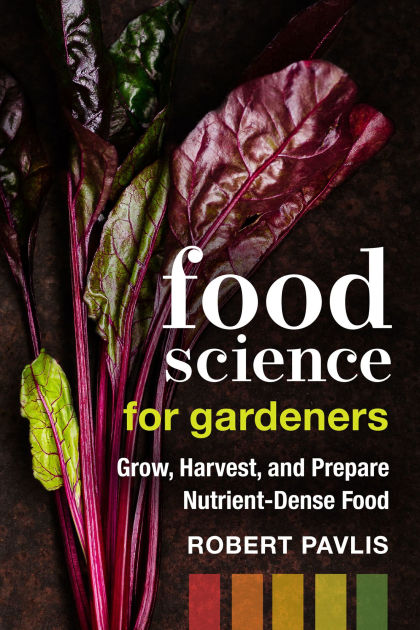
by Robert Pavlis
New Society Publishers, 2024, 214 pages
Book review by Pam Dawling
Here is another concise and helpful book from Robert Pavlis in his Garden Science series, joining Microbe Science, Compost Science, Plant Science, and Soil Science, all For Gardeners. This book will help you understand food nutrients and maximize the nutritional quality and flavor of your garden produce. It provides a concise source of information on nutrition, food safety and food storage with no fluff.
This book will be useful anyone growing or buying produce. Robert Pavlis is well-known as a myth-buster. Here you can read clearly explained science behind food, giving you a clearer idea of which of the ideas you hold are science-based and which are just stories. Mostly I found my beliefs confirmed by science, occasionally I was surprised!
Food Science for Gardeners starts with what food quality is, an intro to how gardeners can affect quality, and a brief history of food science. The opening page lists the contents of a banana: 75% water, 12% sugars, 3% fiber, 1% amino acids, 1% fatty acids, down through smaller amounts of things harder to pronounce if you never studied chemistry. This is to shake us out of any knee-jerk belief that natural foods don’t include ingredients with long chemical names.
A healthy diet needs to include all the essential nutrients and exclude toxic chemicals and carcinogens. How we garden affects what we later eat! We may not always be eating the highest quality food, despite our beliefs, as our five senses don’t give us all the information.
Store-bought food takes about 5 days to get to the store in North America. Some nutrients (vitamins and antioxidants) deteriorate fast after harvest. Imported produce is usually worse on those nutrients as it’s been in transit for over two weeks. But not all nutrients decline so fast. While it’s true that fresh home-grown produce is generally better than imported foods, stored or processed home-grown foods can end up lower in some nutrients than freshly harvested imported foods!
Helping plants grow to their full potential is likely to produce more nutritious food, so continue to do that while studying the details here. Many gardeners do not test their soil for nutrient content, simply assuming the plants will find all they need. But maybe your soil is short of calcium, for example? Maybe the compost you make has a well-rounded nutrient profile. But maybe it doesn’t. We don’t test our harvested food. Did our crops get plenty of sunshine, or did it rain for a month? A high yield, fantastic taste or beautiful appearance does not measure the nutrient quality.
Calories are a measure of a food’s stored energy, which we use to function, stay within our temperature range, and continue all our chemical reactions. Calorie content is only one feature of food value.
Proteins include enzymes, antibodies, messengers and transporters. They are long chains of amino acids, folded in complex structures. Human bodies have about 100,000 different proteins. Of the 20 types of amino acids making up these proteins, we can make 11, while the others (the essential amino acids) must be got from our food. Most sources of plant protein don’t contain all nine essential amino acids. As we learned from Diet for a Small Planet by Frances Moore Lappé in the seventies, a combination of foods can provide complementary amino acids.
The section on carbohydrates explains that some (raffinose in dried beans) are indigestible except by the bacteria in our colons. Fiber is indigestible carbohydrate that keeps our digestive systems functioning, and reduces the chance of colon cancer.
Fats are classified as saturated (solid at room temperature) or unsaturated (oils). Generally, unsaturated fatty acids are considered healthier. Getting some fats is important because they contain fat-soluble vitamins. Also, fats provide lots of energy, with 9 calories per gram compared to 4 in carbs and proteins. Our bodies can synthesize most of the fatty acids, but not linoleic acid (an omega-6 fatty acid in soybean oil, corn oil and safflower oil) or alpha-linoleic acid (an omega-3 fatty acid in soybean oil, canola oil, walnuts and flaxseed). Neither are found in meat. Olive oil and coconut oil (currently trending) have relatively small amounts.
Vitamins in some cases can be made in our bodies from previtamins/provitamins. The best-known example is beta-carotene, a provitamin A. While vitamin A is found only in animal foods, beta-carotene and alpha-carotene are found in plant foods.
Vitamins are categorized as fat-soluble (A, D, E, K) or water-soluble (C and B-complex). The fat-soluble ones can be stored in the body, but water-soluble ones are needed daily because any excess is excreted in urine. A healthy diet provides all the vitamins you can use. Taking excess fat-soluble vitamins is a health hazard, whereas excess water-soluble ones are a simple waste of money. The book details good sources of each vitamin and the benefits they provide.
A daily dose of vitamin C cannot prevent a cold. Hygiene might. Vitamin D can be produced in the body if the face (or more skin) is exposed to UVB rays from the sun for one hour or more a day. Our gut bacteria are an important source of vitamin K. B vitamins are found in many plant and animal foods, so, as always, eat a varied diet. B9, folate, can be hard for our digestive systems to absorb.
The section on minerals comes with a full-page table of what each does and where it’s found. Some can be hard to absorb if they get tied up by other nutrients. Oxalic acid in spinach and rhubarb, and phytic acid in seeds, legumes, and nuts can all bind with calcium in our gut, rendering those nutrients unabsorbable.
Phytochemicals are a vast range of compounds that seem beneficial, but little is yet known with certainty. They are found only in plants.
Antioxidants neutralize free radicals, harmful compounds traveling around our bodies. There are many kinds of both free radicals and antioxidants, and only a matched antioxidant will neutralize a given free radical. Don’t take tons of one assuming it will fix all that ails you. Try to include many different ones in your diet.
The next nutrient covered is water. If you are comparing the prices of various foods at the store, consider the water content. You might be buying expensive water! Our bodies lose (and need) about half a gallon (2 liters) of water each day, more in hot climates, or with vigorous activity. About 20% of this amount can come from your food. You do not need to drink 8 glasses of water a day! Another myth exploded.
Bottled water is not better than tap water (in developed areas) and has financial and ecological costs. Microplastics are tiny particles that result from plastic degradation. Bottled water can contain 325 particles per liter. Plants can absorb nano-plastics (really tiny particles) via their roots. We need to pay attention and not be panicked by sensationalized accounts of whatever chemical has just been found in drinking water or breast milk. Trace amounts might not be worth worrying about, compared to other risks in your life.
A series of Nutrition Myths closes this chapter. Caffeinated beverages in moderation do not dehydrate you. This is one myth I have myself countered for years! Eggs don’t seem to raise cholesterol, even though they contain high levels of cholesterol. We all need to watch out for high-sodium foods, not just people with high blood pressure. From a nutritional perspective, white sugar, brown sugar and “natural sugars” are all sucrose, none better than the others. Also, most of the sugar in honey, maple syrup and coconut sugar is sucrose, and the 22 amino acids, 31 minerals and vitamins and enzymes in honey are in such tiny amounts that they don’t provide any real nutritional value.
Not all natural chemicals are safe, not all synthetic chemicals are dangerous. Multivitamin pills are mostly synthetic chemicals. We need to assess the benefits and hazards of compounds individually, not generalize. Any chemical (including water) can cause poisoning if the dose is high enough. Acute toxicity refers to a one-time exposure at a high dose. It is measured as the LD50, the dose at which half of the poor test animals die within a certain time.
Concentrated vinegar is sometimes used to kill weeds. The oral LD50 of acetic acid (the active ingredient) is 3,310 mg/kg. The oral LD50 of glyphosate, the active ingredient in Roundup, is 5,600 mg/kg. Surprising but true. The short half-life of many modern pesticides means they don’t persist for long. Some pass straight through us, some are digested. And yet, it’s wisest to minimize the amount of pesticides we eat.
The Dirty Dozen is a list of the 12 fruits and vegetables most contaminated by pesticides. I have taken it quite seriously. But the amounts of pesticides found by the USDA in tested produce were considerably below the EPA’s tolerance level. How trustworthy is the EPA‘s assessment of toxicity? If it’s based on the LD50, that’s factual. The author’s conclusion is that all these crops are safe to eat.
Plants make natural pesticides for their own protection. We ingest these pesticides when we eat the crop. We don’t want to fall into the “naturalistic fallacy” of assuming that everything natural is safer and better (think of castor bean seeds). In most cases, plant-made pesticides have not been laboratory tested to determine the LD50, and we have been eating those crops for generations without disaster. Home remedies are sometimes used without thought to their toxicity: dish soap, salt, mothballs.
It is worthwhile minimizing the heavy metals in your garden, especially if you live in an old neighborhood. Get the soil tested for lead. If your soil is contaminated you could forego vegetables for a few years and grow super-accumulator plants such as sunflowers (and totally remove them), until tests show safe results. Then start with fruiting crops that don’t absorb as much as roots, stems or leafy crops. Avoid growing food in the worst kinds of plastic. Particularly avoid the group of plasticizers known as phthalates, found in flexible plastics, like PVC. Meanwhile also avoid non-essential plasticizers, found in cosmetics and some floorings.
Pavlis is quite accepting of GMOs as harmless, although he is only considering the effect on the diners, not the wider effects. Mostly, growing GMOs is not a worry of gardeners, as the Purple Tomato is the only GMO vegetable available to home gardeners. Most of us accepted the GMO Covid vaccines to save us from a bad pandemic. This doesn’t mean we accept all and every GMO out there.
The next section covers food allergies and sensitivities, two illnesses that get confused, and often self-diagnosed wrongly. Food allergies cause a general physical reaction, usually very quickly (hives, drop in blood pressure, fainting, loss of consciousness, which can be life-threatening). The most common food allergens are milk, eggs, fish, shellfish, peanuts, tree nuts, wheat, soy.
Food intolerances are not allergies. They are usually a response from the digestive system, which can include gas, bloating, diarrhea, constipation, cramping and nausea. Unpleasant but not life-threatening. Of a study group with self-reported gluten sensitivity, only 25% had the right symptoms! 30% of Americans are apparently avoiding gluten, but only 1% has celiac disease.
Illness can happen when you ingest toxic compounds made by food poisoning organisms, whether the organisms are still alive when you eat the food or not. Food poisoning organisms can cause nausea and diarrhea and sometimes fever. Different people eating the same food can have different reactions. Stomach acid may kill food poisoning bacteria. Some people can be healthy carriers of food poisoning, spreading the organisms to other people. Food poisoning generally takes 4-24 hours to start but may take longer.
“Use By”, “Best By” and “Expiry” dates are nothing to do with food safety! They are about best quality. Use your own judgement about safety. Wash your hands, wash your produce, keep harvested produce cold or cool. Pavlis explodes 13 food safety myths.
What is nutrient density? I’ve been wondering for several years how we can know the quality of our food. Nutrient-dense foods contain vitamins, minerals, complex carbohydrates, lean protein and healthy fats, adding up to food high in nutrients while relatively low in calories. Rather vague and unquantifiable, making it difficult to make wise choices, whether in the store or when selecting varieties to grow.
Brix is a measure of the total soluble solids in a sample. A refractometer measures the concentration of soluble solids in water by how much they bend (refract) a beam of light passing through. If the sample has lots of water, it will give a low reading (all other ingredients are diluted by the water). It is a mistake to think a high Brix reading is a sign of plentiful nutrients. Drier fruits get higher readings, but shriveled tomatoes aren’t more nutritious. Brix readings cannot tell you the quantity of vitamins for instance, as their concentration is low compared to carbohydrates and proteins. Brix is not a useful measure of nutrition.
Soil fertility affects the food it grows. Some studies showed that nutrient levels in today’s food are less than they were 50 years ago. Believing this indicated declining soil fertility, some people decided to “remineralize” the soil with rock dusts. When we harvest crops we remove some soil nutrients. But which nutrients, and how quickly? Soil containing 2% of iron has 400,000mg /sq ft in the plow layer. A 50 g carrot contains 0.3 mg of iron. 1 sq ft of soil has enough iron to grow 1.3 million carrots, enough for 250,000 years at 5 carrots/sq ft. Meanwhile, rock is slowly but steadily wearing down, releasing more plant micro-nutrients. We also add nutrients as fertilizer, compost and manure. The soil is not running out of nutrients.
A commonly quoted study said that 43 foods show apparent declines over 50 years for 6 nutrients (protein, Ca, P, Fe, riboflavin and vitamin C), but no reliable decline for 7 other nutrients. There have been changes in cultivars over the 50 years, perhaps favoring yield or some other factor over nutrient content.
We eat from hunger and because we enjoy the flavor of food. Flavor includes aroma, taste and texture, and is created in our mind from these inputs, as well as appearance. Our sense of flavor and smell decrease as we age; the number of taste buds decreases after about the age of 50; our mouths become drier as we produce less saliva. Yes, food really doesn’t taste as good as it used to!
Aroma depends on volatile compounds landing in our noses. People can detect more than 10,000 different smells. We can also detect odors that move from our mouth to our nose as we chew, and this may account for 80% of the flavor. Texture is perceived by the tongue, teeth and jaws. Taste incorporates five main types: salty, sweet, sour, bitter and umami. That old tongue diagram with different areas marked as having more taste buds for a certain taste has been debunked. Try it for yourself.
Twenty of the most important flavor compounds in tomatoes are all composed from important nutrients. But can we determine the nutritional level of food from the flavor? Yes, somewhat. The modern-day commercial focus on yield and shippability means less attention to flavor (and somewhat less to nutrition too). Manufactured food products have ingredients added to please us, not feed us. Sugar, salt and fat appeal to our taste buds, tricking us into eating products that are not nutritious.
Sugar masks most acid flavors. People often choose a high sugar tomato thinking they’ve selected a low acid one. Nutritionists define a tomato as low acid if the pH is above 4.6. A variety might be low-acid in one location, but in normal range elsewhere. Studies of 58 tomato cultivars grown in Maryland and 356 cultivars and 112 breeding lines across the US, covering 57 locations in 23 states lead to the conclusions that small varieties and yellow or orange tomatoes are not low acid. Heirloom varieties and modern cultivars have very similar pH, with some of each having less acid. (At a pH below 4.6 Clostridium botulinum will not grow.) Catalog tags of “low acid” cannot be trusted. Search university research and extension services, looking for pH numbers rather than “low-acid” labels.
Climate and soil affect the nutrients your crops contain. Sulfur levels in soil play a major role in the pungency of onions grown there. Too much water during growth can reduce flavor. Cucumbers get bitter if they don’t get enough water, sun or organic matter, or if temperature fluctuates more than 20F (11C), or is particularly cold or hot. A study of 28 herbicides tested on a variety of crops found that 11 reduced the flavor, 2 produced a slight off-flavor and the other 18 had no effect on taste.
This is not a gardening book, but a food book with some gardening tips. Unfortunately, there is no way to measure the nutritional value of the food you grow. Pavlis recommends focusing on growing more food, as much as you can, rather than worrying about the precise content of your produce. You will get more satisfaction and more fresh food. Which is more valuable, one carrot with 10% more vitamin A or two carrots with less? Two carrots will have more vitamin A than one carrot with a 10% increase. Eating more vegetables and fruit will make you healthier. Worrying won’t.
Because variety selection has the biggest impact on flavor, and because flavor varies from one location to another, seek advice from local gardeners and Extension office. Design your garden so that your crops are available over a long harvest period. Using varieties with fewer days to maturity brings you food sooner. Harvest vegetables promptly, and you will get higher yields over the time (for crops that yield more than a single head). Plants start to shut down once they have some seed maturing, and frequent picking removes that message to the plant. Sow more than once, to get continuous harvests without gaps. Look for warm weather and cool weather variants of the crops you like. Start crops indoors in spring, so you can transplant as soon as the weather warms enough. Use row covers, insect netting or shade cloth to give your plants extra protection. Make sure you provide all the water the crops can use.
Don’t be seduced by beliefs that heirlooms are better just because they’ve been around longer, or that open-pollinated varieties are always better than hybrids. This is magical thinking. Hybrids have been bred by agronomists seeking improvements. Higher yields or resistance to a disease that plagues your region are features worth having. But thick skins for easier shipping are not useful for home gardeners.
Sometimes the author gets a bee in his bonnet that isn’t in my bonnet. He claims that sweet potatoes are natural GMOs because they contain the DNA of a bacterium, and so people growing sweet potatoes are growing GMOs in ignorance. Frankly I don’t care if sweet potatoes contain ancient bacterial DNA. I have read in scientific papers that bacterial DNA is found in the human genome too. It’s not changing my opinion about deliberate genetic engineering. I love sweet potatoes.
Scientific testing so far does not show organically grown food to be more nutritious, safer to eat, or even tastier. Taste is more related to freshness and ripeness. A few studies show more omega-3 fatty acids in organic food. Pavlis seems to delight in busting people’s preferences for organic. But the personal health of consumers is not all that matters. Here, he does not tackle questions of the health of agricultural workers, environmental health or the degradation of land by industrial farming, especially as a result of colonization, when the social consequences as well as the environmental ones get disregarded to favor maximum profit.
Buying from trusted local farmers (organic or not) helps the local economy and brings you fresher food. Sometimes locally grown is not the most sustainable. Growing vegetables in heated greenhouses can use a lot of energy. It might be more sustainable to import from a warmer climate. Or eat different food, of course.
Some fruits continue to ripen after harvest (if not picked too immature). After harvest, the starches continue changing into sugars. They can be kept at room temperature until fully ripe, then eaten or refrigerated. Once tomatoes have passed the Breaker Stage (green with a reddish blush), they can ripen fully off the vine, tasting as good as if ripened on the plant. This can be a useful strategy to avoid predation of ripe fruit. For some foods we want to slow the process, either to pace the usefulness for eating or because those crops deteriorate if too mature. Carrots become bitter, broccoli yellows as the flower buds open.
Food preservation starts in the garden. Avoid harvesting leafy greens, nightshades, cucurbits or legumes when the dew is still on the plants, as it can spread fungal diseases. Harvesting as early as harmless, when the air is cool, gets the vegetables in best condition. Keep produce out of sunlight or heat. Wash hands before and after harvesting. Warm water can remove all the germs, but tepid water only gets 90%. Neither soap nor dish soap (actually detergent) kills germs. The germs are merely flushed off your skin, down the sink. Don’t wear gloves – they are worse than skin for collecting germs.
Remove visible dirt asap, otherwise, don’t wash until you are ready to prepare the food for eating. It is important that wash water is the same temperature as the produce, within 10F degrees (5C degrees). Cold water causes microorganisms to be sucked into the vegetables. Tap water is as effective as commercial products or “home remedy” additives such as vinegar or baking soda, which flavor the food. For crops sprayed with synthetic pesticides, try washing soda or baking soda. Avoid vinegar or salt in washing water, as these can react with the pesticide to make things worse.
If you drop food on the floor, it will pick up germs in an instant, contrary to myths and contrary to the visible robust health of Julia Child on her TV cooking show. Longer time on the floor means more microbes on the food, but even 5 seconds is long enough to pick up too many.
In general, store cool-weather crops at lower temperatures (refrigerator conditions), and warm weather ones at 45-55F (7-13C). Crisper drawers are not decorative! They keep the contents more enclosed, and more humid, than the body of the fridge.
There is a table of storage conditions, divided by room or fridge temperature, whether the crop continues ripening after harvest, whether it produces ethylene and whether it is sensitive to ethylene. No numbers, very easy to follow.
The chapter on preserving food stresses the importance of preserving freshness, flavor and nutrition while also preventing the food from spoiling. Preserving techniques often compromise the taste, texture, color and (unmeasurable at home) nutrient levels. Benefits must be balanced with the negative effects. No single preservation technique is best for all crops. The University of Minnesota has great food preservation info.
Freezing stops bacterial activity but does not kill all microbes or enzymes. Boiling or blanching destroys enzymes and kills most microbes. Pressure cookers can kill microbes that survive beyond normal boiling point up to 248F (120C). Pickling (adding acids) and fermentation (producing alcohol) can kill some microbes and deactivate enzymes. Smoke adds formaldehyde, which has negative effects on microbes (and people). Sugar and salt can preserve food by drawing water out of the food cells and killing bacteria. Fungi can continue growing in high sugar or salt environments. Blanching in steam or boiling water deactivates enzymes and is normally followed by freezing.
Water bath canning (for produce with pH below 4.6) and pressure canning (for low acid foods with pH above 4.6) are great ways to preserve food without electricity. In a pressure cooker at 30 psi, water boils at 121F (250C), hot enough to kill all microbes. There is a sidebar on minimizing the risks of botulism. Another chart sets out how to can 14 different foods in quart jars, either using a water bath (when appropriate) or a pressure canner. Three pressure cooking myths are defanged.
Food drying (mysteriously now called dehydrating) is simple. Once deprived of water, the food cannot harbor microbes or enzymes. Food drying needs to happen slowly, at a fairly low temperature. If you need to dry food faster, slice it thinner. Do not try drying fatty foods.
Freeze drying removes water from food after it is frozen, using a vacuum that converts the ice into water vapor to remove it. Once freeze-drying is completed, the food can be stored in plastic bags or jars at room temperature.
Fermentation converts molecules such as starches and sugars into organic acids and alcohols, via either lactic acid fermentation or alcoholic fermentation. Lactic acid fermentation is mostly a bacterial process. It is used for pickles, sauerkraut, yogurt and cheese. Alcoholic fermentation is carried out by yeast, fungi and some bacteria, producing yeasted bread, wine and beer.
Pickling uses vinegar, water, salt and sometimes sugar. It gives an acidic flavor. Don’t reduce the salt in pickle recipes – it needs to be there. Drinking pickle juice has become a trend, with vinegar providing possible benefits for diabetes, weight loss and muscle cramps. Only fermented pickles provide probiotics. Fermentation also reduces toxins in the food, such as phytic acid in soybeans.
Packing food in oil is not a safe way to preserve vegetables. Botulism can grow quite well in oil. Pasteurization normally destroys pathogens. This is useful for milk and fruit juices. Vacuum sealing can be used for some preservation, extending shelf life 2-5 times as long, and enabling items to be kept at room temperature. Leafy greens, raw onions and garlic, mushrooms, and cooked vegetables are not recommended for vacuum sealing.
The closing chapters cover cooking food and growing it. There are tips on eleven specific vegetables, and that chapter is necessarily short. Anyone reading this book for growing pointers would likely be disappointed. The book’s strengths lie in the information on nutrients in food, which is presented clearly and concisely and is hard to find elsewhere.